


Page 8 - Read Online
P. 8
Review  |  Open Access

                                    Cancer Drug Resistance


                                       Cheng et al. Cancer Drug Resist. 2025;8:46      DOI:10.20517/cdr.2025.132


               Targeting the hypoxia signaling pathway with
               nanomedicine to reverse immunotherapy resistance


               Xiaoliang Cheng 1,2,3,# , Peixing Wang , Hongqiang Lyu , Yonghyun Lee , Juyoung Yoon , Haiyan Dong 1
                                                                                         3,6
                                             4,#
                                                                          2,6
                                                            5
               Keywords:
               Immunotherapy resistance,
               HIF-1a, tumor-associated
               macrophages, T cell
               exhaustion, immune
               evasion, vascular
               normalization,
               nanomedicine

               Citation: Cheng X, Wang P,
               Lyu H, Lee Y, Yoon J, Dong H.
               Targeting the hypoxia
               signaling pathway with
               nanomedicine to reverse
               immunotherapy resistance.
               Cancer Drug Resist.
               2025;8:46.
               https://dx.doi.org/10.20517
               /cdr.2025.132
                                   Abstract
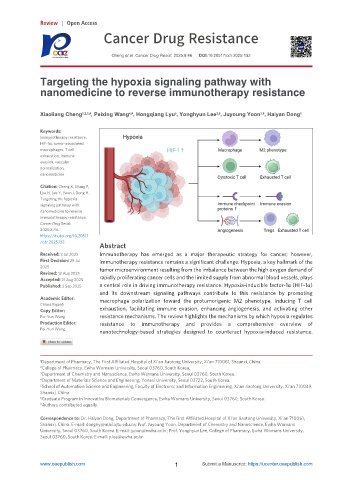
               Received: 3 Jul 2025  Immunotherapy   has   emerged   as   a   major   therapeutic   strategy   for   cancer;   however,
               First Decision: 29 Jul  immunotherapy resistance remains a significant challenge. Hypoxia, a key hallmark of the
               2025                tumor microenvironment resulting from the imbalance between the high oxygen demand of
               Revised: 12 Aug 2025
               Accepted: 21 Aug 2025  rapidly proliferating cancer cells and the limited supply from abnormal blood vessels, plays
               Published: 2 Sep 2025  a central role in driving immunotherapy resistance. Hypoxia-inducible factor-1α (HIF-1α)
                                   and   its   downstream   signaling   pathways   contribute   to   this   resistance   by   promoting
               Academic Editor:    macrophage   polarization   toward   the   protumorigenic   M2   phenotype,   inducing   T   cell
               Chiara Riganti      exhaustion,   facilitating   immune   evasion,   enhancing   angiogenesis,   and   activating   other
               Copy Editor:
               Pei-Yun Wang        resistance mechanisms. The review highlights the mechanisms by which hypoxia regulates
               Production Editor:  resistance   to   immunotherapy   and   provides   a   comprehensive   overview   of
               Pei-Yun Wang
                                   nanotechnology-based   strategies   designed   to   counteract   hypoxia-induced   resistance.


               1 Department of Pharmacy, The First Affiliated Hospital of Xi’an Jiaotong University, Xi’an 710061, Shaanxi, China.
               2 College of Pharmacy, Ewha Womans University, Seoul 03760, South Korea.
               3 Department of Chemistry and Nanoscience, Ewha Womans University, Seoul 03760, South Korea.
               4 Department of Materials Science and Engineering, Yonsei University, Seoul 03722, South Korea.
               5 School of Automation Science and Engineering, Faculty of Electronic and Information Engineering, Xi’an Jiaotong University, Xi’an 710049,
               Shaanxi, China.
               6 Graduate Program in Innovative Biomaterials Convergence, Ewha Womans University, Seoul 03760, South Korea.
               # Authors contributed equally.

               Correspondence to: Dr. Haiyan Dong, Department of Pharmacy, The First Affiliated Hospital of Xi’an Jiaotong University, Xi’an 710061,
               Shaanxi, China. E-mail: donghy@mail.xjtu.edu.cn; Prof. Juyoung Yoon, Department of Chemistry and Nanoscience, Ewha Womans
               University, Seoul 03760, South Korea. E-mail: jyoon@ewha.ac.kr; Prof. Yonghyun Lee, College of Pharmacy, Ewha Womans University,
               Seoul 03760, South Korea. E-mail: y.lee@ewha.ac.kr


               www.oaepublish.com                           1        Submit a Manuscript: https://ucenter.oaepublish.com

