


Page 98 - Read Online
P. 98
Page 252                                                                Shi et al. Art Int Surg 2024;4:247-57  https://dx.doi.org/10.20517/ais.2024.17


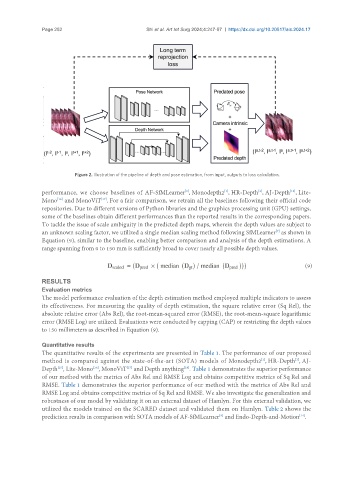
                          Figure 2. Illustration of the pipeline of depth and pose estimation, from input, outputs to loss calculation.


               performance, we choose baselines of AF-SfMLearner , Monodepth2 , HR-Depth , AJ-Depth , Lite-
                                                                             [1]
                                                                                        [3]
                                                                                                   [15]
                                                               [9]
                                   [17]
                    [16]
               Mono  and MonoViT . For a fair comparison, we retrain all the baselines following their official code
               repositories. Due to different versions of Python libraries and the graphics processing unit (GPU) settings,
               some of the baselines obtain different performances than the reported results in the corresponding papers.
               To tackle the issue of scale ambiguity in the predicted depth maps, wherein the depth values are subject to
               an unknown scaling factor, we utilized a single median scaling method following SfMLearner  as shown in
                                                                                              [7]
               Equation (9), similar to the baseline, enabling better comparison and analysis of the depth estimations. A
               range spanning from 0 to 150 mm is sufficiently broad to cover nearly all possible depth values.
                                                                                                        (9)


               RESULTS
               Evaluation metrics
               The model performance evaluation of the depth estimation method employed multiple indicators to assess
               its effectiveness. For measuring the quality of depth estimation, the square relative error (Sq Rel), the
               absolute relative error (Abs Rel), the root-mean-squared error (RMSE), the root-mean-square logarithmic
               error (RMSE Log) are utilized. Evaluations were conducted by capping (CAP) or restricting the depth values
               to 150 millimeters as described in Equation (9).


               Quantitative results
               The quantitative results of the experiments are presented in Table 1. The performance of our proposed
                                                                                         [1]
               method is compared against the state-of-the-art (SOTA) models of Monodepth2 , HR-Depth , AJ-
                                                                                                     [3]
               Depth , Lite-Mono , MonoViT  and Depth anything . Table 1 demonstrates the superior performance
                    [15]
                                                               [18]
                                [16]
                                            [17]
               of our method with the metrics of Abs Rel and RMSE Log and obtains competitive metrics of Sq Rel and
               RMSE. Table 1 demonstrates the superior performance of our method with the metrics of Abs Rel and
               RMSE Log and obtains competitive metrics of Sq Rel and RMSE. We also investigate the generalization and
               robustness of our model by validating it on an external dataset of Hamlyn. For this external validation, we
               utilized the models trained on the SCARED dataset and validated them on Hamlyn. Table 2 shows the
                                                                           [9]
                                                                                                      [14]
               prediction results in comparison with SOTA models of AF-SfMLearner  and Endo-Depth-and-Motion .

