


Page 73 - Read Online
P. 73
Kimbowa et al. Art Int Surg 2024;4:149-69  https://dx.doi.org/10.20517/ais.2024.20                                                                                                                                                      Page 163


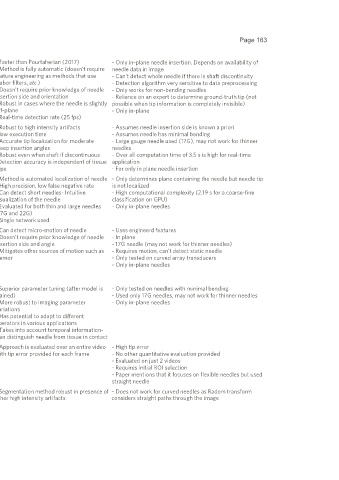
 - Faster than Pourtaherian (2017)      - Only in-plane needle insertion. Depends on availability of
 - Method is fully automatic (doesn’t require  needle data in image
 feature engineering as methods that use   - Can’t detect whole needle if there is shaft discontinuity
 Gabor filters, etc.)                   - Detection algorithm very sensitive to data preprocessing
 - Doesn’t require prior knowledge of needle   - Only works for non-bending needles
 insertion side and orientation         - Reliance on an expert to determine ground-truth tip (not
 - Robust in cases where the needle is slightly  possible when tip information is completely invisible)
 off-plane                              - Only in-plane
 - Real-time detection rate (25 fps)
 [60]
 2017-  Mwikirize et al.  3D  (1) Detect slices with needle   - Robust to high intensity artifacts   - Assumes needle insertion side is known a priori
 09-08  (2) Enhance needle and localize it in all slices (multi-plane)  - low execution time   - Assumes needle has minimal bending
 - Accurate tip localization for moderate   - Large gauge needle used (17G), may not work for thinner
 steep insertion angles                 needles
 - Robust even when shaft if discontinuous   - Over all computation time of 3.5 s is high for real-time
 -Detection accuracy is independent of tissue  application
 type                                   - For only in plane needle insertion

 2017-  Pourtaherian et al. [71]  3D  - Extract voxels from 3D ultrasound volume   - Method is automated localization of needle  - Only determines plane containing the needle but needle tip
 09-04  - Classify each voxel as needle or background   - High precision, low false negative rate   is not localized
 - Estimate needle axis by fitting a model of the needle to the   - Can detect short needles- Intuitive   - High computational complexity (2.19 s for a coarse-fine
 detected voxels (model is a straight cylinder having a fixed   visualization of the needle   classification on GPU)
 diameter)   - Evaluated for both thin and large needles   - Only in-plane needles
 - Visualize the 2D cross section plane that that contains the   (17G and 22G)
 entire needle  - Single network used
 [69]
 2017-  Beigi et al.  2D+t  (1) Capture micro-motion of needle by extracting spatio-  - Can detect micro-motion of needle   - Uses engineerd features
 06-24  temporal features of cuboids from optical and differential flow   - Doesn’t require prior knowledge of needle   - In plane
 maps at multiple scales and orientations using a steerable   insertion side and angle   - 17G needle (may not work for thinner needles)
 complex pyramid   - Mitigates other sources of motion such as   - Requires motion, can’t detect static needle
 (2) Pass features to incremental SVM to classify pixels as   tremor  - Only tested on curved array transducers
 needle or background in current frame   - Only in-plane needles
 (3) Apply Hough Transform on segmentation to determine
 needle trajectory
 [55]
 2017-  Beigi et al.  2D+t  (1) Segmentation (using a learning-based framework to classify  - Superior parameter tuning (after model is   - Only tested on needles with minimal bending
 03-06  pixels based on temporal analysis of phase variations to obtain  trained)   - Used only 17G needles, may not work for thinner needles
 a probability map)   - More robust to imaging parameter   - Only in-plane needles
 (2) Localization (use a Hough Transform on the probability map  variations
 to localize the needle)  - Has potential to adapt to different
 operators in various applications
 - Takes into account temporal information-
 Can distinguish needle from tissue in contact

 2014-  Geraldes and   2D  (1) ROI selection   - Approach is evaluated over an entire video  - High tip error
 [70]
 10-02  Rocha  (2) MLP prediction   with tip error provided for each frame  - No other quantitative evaluation provided
 (3) Kalman filter to improve robustness  - Evaluated on just 2 videos
                                        - Requires initial ROI selection
                                        - Paper mentions that it focuses on flexible needles but used
                                        straight needle
 [67]
 2014-  Hatt et al.  2D  2 stages   - Segmentation method robust in presence of  - Does not work for curved needles as Radom transform
 07-06  other high intensity artifacts   considers straight paths through the image

