


Page 68 - Read Online
P. 68
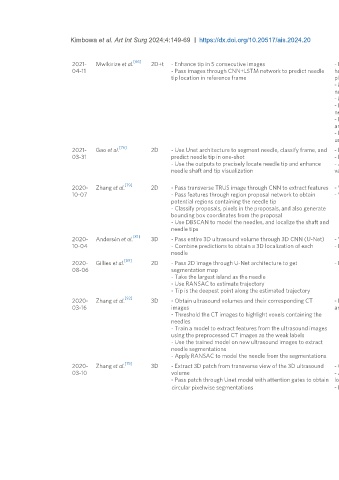
Kimbowa et al. Art Int Surg 2024;4:149-69    https://dx.doi.org/10.20517/ais.2024.20                                                                                                                                                      Page 161


                                                [66]
                          2021-    Mwikirize et al.   2D+t   - Enhance tip in 5 consecutive images                    - Does not rely on needle shaft visibility,   - Straight needles
                          04-11                              - Pass images through CNN+LSTM network to predict needle   hence, works for both in plane and out of   - Does not localize the shaft- Limited evaluations performed
                                                             tip location in reference frame                          plane detection                          for needle sizes, motion and high intensity artifacts, insertion
                                                                                                                      - Models temporal dynamics associated with  angles, tissue types, domain invariance across imaging
                                                                                                                      needle tip motion                        systems
                                                                                                                      - More accurate
                                                                                                                      - Does not require a priori information about
                                                                                                                      needle trajectory
                                                                                                                      - Performs well in presence of high intensity
                                                                                                                      artifacts
                                                                                                                      - Not sensitive to type and size of needle
                                                                                                                      used
                                           [76]
                          2021-    Gao et al.         2D     - Use Unet architecture to segment needle, classify frame, and   - Real-time                      - Requires beam steering
                          03-31                              predict needle tip in one-shot                           - Localization and segmentation in one shot   - Needle after beam steering is visible enough (questions
                                                             - Use the outputs to precisely locate needle tip and enhance   - Approach extensively evaluated using   need for algorithm)
                                                             needle shaft and tip visualization                       various metircs                          - Has a classification network that is not necessary
                                                                                                                                                               - Can only work for in-plane needles
                                             [79]
                          2020-    Zhang et al.       2D     - Pass transverse TRUS image through CNN to extract features  - Works for multiple needles        - Inference time evaluated on GPU which may not reflect
                          10-07                              - Pass features through region proposal network to obtain   - Works for 3D and 2D needle localization  performance on low-compute devices
                                                             potential regions containing the needle tip                                                       - Only in-plane needle insertion
                                                             - Classify proposals, pixels in the proposals, and also generate
                                                             bounding box coordinates from the proposal
                                                             - Use DBSCAN to model the needles, and localize the shaft and
                                                             needle tips
                                                [81]
                          2020-    Andersén et al.    3D     - Pass entire 3D ultrasound volume through 3D CNN (U-Net)   - Works for multiple needles          - Does not localize the needle tip
                          10-04                              - Combine predictions to obtain a 3D localization of each   - Doesn’t require any preprocessing   - Only applicable to multiple needles and 3D ultrasound
                                                             needle
                                             [89]
                          2020-    Gillies et al.     2D     - Pass 2D image through U-Net architecture to get        - Evaluated on various target organs     - Localization requires knowledge of needle entry direction
                          08-06                              segmentation map                                                                                  - Not optimized for real-time performance
                                                             - Take the largest island as the needle
                                                             - Use RANSAC to estimate trajectory
                                                             - Tip is the deepest point along the estimated trajectory
                                             [92]
                          2020-    Zhang et al.       3D     - Obtain ultrasound volumes and their corresponding CT   - Doesn’t need manual labels as CT images   - Requires CT image to train
                          03-16                              images                                                   are used as weak labels                  - Limited to brachytherapy application
                                                             - Threshold the CT images to highlight voxels containing the
                                                             needles
                                                             - Train a model to extract features from the ultrasound images
                                                             using the preprocessed CT images as the weak labels
                                                             - Use the trained model on new ultrasound images to extract
                                                             needle segmentations
                                                             - Apply RANSAC to model the needle from the segmentations
                                             [75]
                          2020-    Zhang et al.       3D     - Extract 3D patch from transverse view of the 3D ultrasound   - Can detect multiple needles at once   - Can only work for 3D ultrasound
                          03-10                              volume                                                   - Achieves both segmentation and
                                                             - Pass patch through Unet model with attention gates to obtain  localization of the needles simultaneously
                                                             circular pixelwise segmentations                         - Fast as compared to manual segmentation

