


Page 62 - Read Online
P. 62
Page 156                                                      Kimbowa et al. Art Int Surg 2024;4:149-69  https://dx.doi.org/10.20517/ais.2024.20


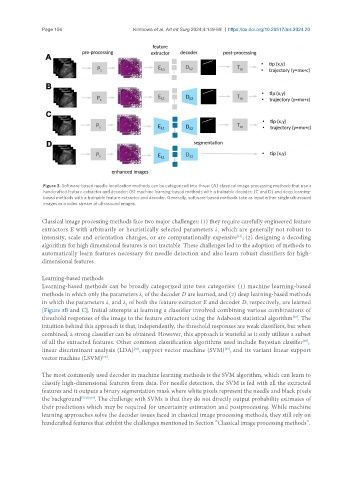
                Figure 3. Software-based needle localization methods can be categorized into three: (A) classical image processing methods that use a
                handcrafted feature extractor and decoder; (B) machine learning-based methods with a trainable decoder; (C and D) and deep learning-
                based methods with a trainable feature extractor and decoder. Generally, software-based methods take as input either single ultrasound
                images or a video stream of ultrasound images.


               Classical image processing methods face two major challenges: (1) they require carefully engineered feature
               extractors E with arbitrarily or heuristically selected parameters λ  which are generally not robust to
                                                                          1
                                                                                 [63]
               intensity, scale and orientation changes, or are computationally expensive ; (2) designing a decoding
               algorithm for high dimensional features is not tractable. These challenges led to the adoption of methods to
               automatically learn features necessary for needle detection and also learn robust classifiers for high-
               dimensional features.


               Learning-based methods
               Learning-based methods can be broadly categorized into two categories: (1) machine learning-based
               methods in which only the parameters λ  of the decoder D are learned, and (2) deep learning-based methods
                                                 2
               in which the parameters λ  and λ  of both the feature extractor E and decoder D, respectively, are learned
                                      1
                                           2
               [Figure 3B and C]. Initial attempts at learning a classifier involved combining various combinations of
               threshold responses of the image to the feature extractors using the Adaboost statistical algorithm . The
                                                                                                    [67]
               intuition behind this approach is that, independently, the threshold responses are weak classifiers, but when
               combined, a strong classifier can be obtained. However, this approach is wasteful as it only utilizes a subset
               of all the extracted features. Other common classification algorithms used include Bayesian classifer ,
                                                                                                       [68]
                                              [56]
               linear discriminant analysis (LDA) , support vector machine (SVM) , and its variant linear support
                                                                             [60]
               vector machine (LSVM) .
                                   [56]
               The most commonly used decoder in machine learning methods is the SVM algorithm, which can learn to
               classify high-dimensional features from data. For needle detection, the SVM is fed with all the extracted
               features and it outputs a binary segmentation mask where white pixels represent the needle and black pixels
               the background [55,60,69] . The challenge with SVMs is that they do not directly output probability estimates of
               their predictions which may be required for uncertainty estimation and postprocessing. While machine
               learning approaches solve the decoder issues faced in classical image processing methods, they still rely on
               handcrafted features that exhibit the challenges mentioned in Section “Classical image processing methods”.

