


Page 57 - Read Online
P. 57
Kimbowa et al. Art Int Surg 2024;4:149-69  https://dx.doi.org/10.20517/ais.2024.20                                                      Page 151


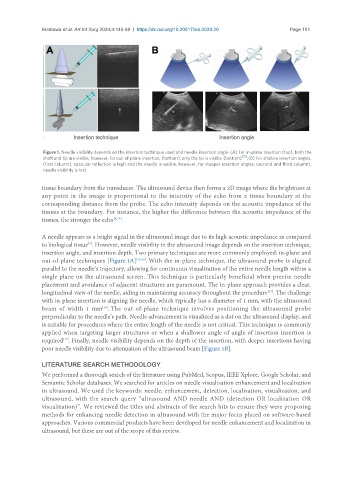
                Figure 1. Needle visibility depends on the insertion technique used and needle insertion angle. (A) For in-plane insertion (top), both the
                shaft and tip are visible; however, for out-of-plane insertion, (bottom), only the tip is visible (bottom) [15] ; (B) For shallow insertion angles,
                (first column), specular reflection is high and the needle is visible; however, for steeper insertion angles, (second and third column),
                needle visibility is lost.


               tissue boundary from the transducer. The ultrasound device then forms a 2D image where the brightness at
               any point in the image is proportional to the intensity of the echo from a tissue boundary at the
               corresponding distance from the probe. The echo intensity depends on the acoustic impedance of the
               tissues at the boundary. For instance, the higher the difference between the acoustic impedance of the
               tissues, the stronger the echo [6,14] .

               A needle appears as a bright signal in the ultrasound image due to its high acoustic impedance as compared
               to biological tissue . However, needle visibility in the ultrasound image depends on the insertion technique,
                               [6]
               insertion angle, and insertion depth. Two primary techniques are more commonly employed: in-plane and
               out-of-plane techniques [Figure 1A] [15,16] . With the in-plane technique, the ultrasound probe is aligned
               parallel to the needle’s trajectory, allowing for continuous visualization of the entire needle length within a
               single plane on the ultrasound screen. This technique is particularly beneficial when precise needle
               placement and avoidance of adjacent structures are paramount. The in-plane approach provides a clear,
               longitudinal view of the needle, aiding in maintaining accuracy throughout the procedure . The challenge
                                                                                           [17]
               with in-plane insertion is aligning the needle, which typically has a diameter of 1 mm, with the ultrasound
               beam  of  width  1  mm . The  out-of-plane  technique  involves  positioning  the  ultrasound  probe
                                   [18]
               perpendicular to the needle’s path. Needle advancement is visualized as a dot on the ultrasound display, and
               is suitable for procedures where the entire length of the needle is not critical. This technique is commonly
               applied when targeting larger structures or when a shallower angle of angle of insertion insertion is
                      [17]
               required . Finally, needle visibility depends on the depth of the insertion, with deeper insertions having
               poor needle visibility due to attenuation of the ultrasound beam [Figure 1B].

               LITERATURE SEARCH METHODOLOGY
               We performed a thorough search of the literature using PubMed, Scopus, IEEE Xplore, Google Scholar, and
               Semantic Scholar databases. We searched for articles on needle visualization enhancement and localization
               in ultrasound. We used the keywords: needle, enhancement, detection, localization, visualization, and
               ultrasound, with the search query “ultrasound AND needle AND (detection OR localization OR
               visualization)”. We reviewed the titles and abstracts of the search hits to ensure they were proposing
               methods for enhancing needle detection in ultrasound with the major focus placed on software-based
               approaches. Various commercial products have been developed for needle enhancement and localization in
               ultrasound, but these are out of the scope of this review.

