


Page 70 - Read Online
P. 70
Cepas-Guillen et al. Vessel Plus 2021;5:26  https://dx.doi.org/10.20517/2574-1209.2020.79  Page 7 of 12


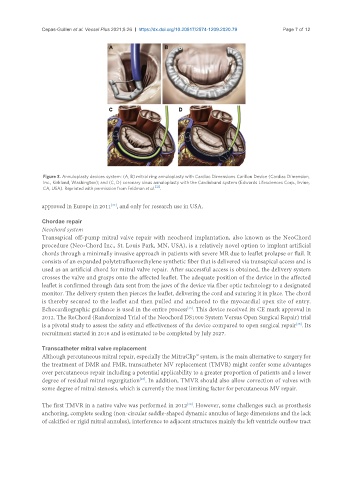
                Figure 3. Annuloplasty devices system: (A, B) mitral ring annuloplasty with Cardiac Dimensions Carillon Device (Cardiac Dimension,
                Inc., Kirkland, Washington); and (C, D) coronary sinus annuloplasty with the Cardioband system (Edwards Lifesciences Corp., Irvine,
                CA, USA). Reprinted with permission from Feldman et al. [32] .


                                      [34]
               approved in Europe in 2011 , and only for research use in USA.
               Chordae repair
               Neochord system
               Transapical off-pump mitral valve repair with neochord implantation, also known as the NeoChord
               procedure (Neo-Chord Inc., St. Louis Park, MN, USA), is a relatively novel option to implant artificial
               chords through a minimally invasive approach in patients with severe MR due to leaflet prolapse or flail. It
               consists of an expanded polytetrafluoroethylene synthetic fiber that is delivered via transapical access and is
               used as an artificial chord for mitral valve repair. After successful access is obtained, the delivery system
               crosses the valve and grasps onto the affected leaflet. The adequate position of the device in the affected
               leaflet is confirmed through data sent from the jaws of the device via fiber optic technology to a designated
               monitor. The delivery system then pierces the leaflet, delivering the cord and suturing it in place. The chord
               is thereby secured to the leaflet and then pulled and anchored to the myocardial apex site of entry.
               Echocardiographic guidance is used in the entire process . This device received its CE mark approval in
                                                                [35]
               2012. The ReChord (Randomized Trial of the Neochord DS1000 System Versus Open Surgical Repair) trial
               is a pivotal study to assess the safety and effectiveness of the device compared to open surgical repair . Its
                                                                                                     [36]
               recruitment started in 2016 and is estimated to be completed by July 2027.

               Transcatheter mitral valve replacement
               Although percutaneous mitral repair, especially the MitraClip™ system, is the main alternative to surgery for
               the treatment of DMR and FMR, transcatheter MV replacement (TMVR) might confer some advantages
               over percutaneous repair including a potential applicability to a greater proportion of patients and a lower
                                                [37]
               degree of residual mitral regurgitation . In addition, TMVR should also allow correction of valves with
               some degree of mitral stenosis, which is currently the most limiting factor for percutaneous MV repair.

                                                                [38]
               The first TMVR in a native valve was performed in 2012 . However, some challenges such as prosthesis
               anchoring, complete sealing (non-circular saddle-shaped dynamic annulus of large dimensions and the lack
               of calcified or rigid mitral annulus), interference to adjacent structures mainly the left ventricle outflow tract

