


Page 32 - Read Online
P. 32
Echarte-Morales et al. Vessel Plus 2021;5:54  https://dx.doi.org/10.20517/2574-1209.2020.105  Page 3 of 13

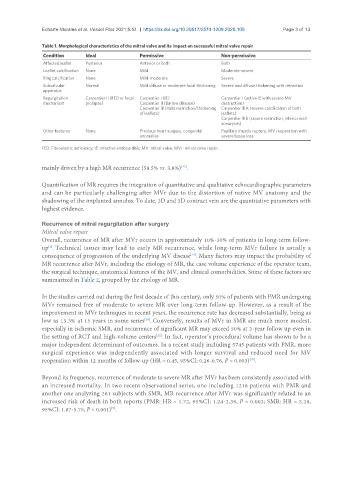
               Table 1. Morphological characteristics of the mitral valve and its impact on successful mitral valve repair
                Condition     Ideal             Permissive                  Non-permissive
                Affected leaflet  Posterior     Anterior or both            Both
                Leaflet calcification  None     Mild                        Moderate-severe
                Ring calcification  None        Mild-moderate               Severe
                Subvalvular   Normal            Mild diffuse or moderate focal thickening  Severe and diffuse thickening with retraction
                apparatus
                Regurgitation   Carpentier II (FED or focal   Carpentier I (IE)   Carpentier I (active IE with severe MV
                mechanism     prolapse)         Carpentier II (Barlow disease)   destruction)
                                                Carpentier III (mild restriction/thickening  Carpentier IIIA (severe calcification of both
                                                of leaflets)                leaflets)
                                                                            Carpentier IIIB (severe restriction, inferior wall
                                                                            aneurysm)
                Other features  None            Previous heart surgery, congenital   Papillary muscle rupture, MV reoperation with
                                                anomalies                   severe tissue loss

               FED: Fibroelastic deficiency; IE: infective endocarditis; MV: mitral valve; MVr: mitral valve repair.

                                                              [12]
               mainly driven by a high MR recurrence (58.5% vs. 3.8%) .

               Quantification of MR requires the integration of quantitative and qualitative echocardiographic parameters
               and can be particularly challenging after MVr due to the distortion of native MV anatomy and the
               shadowing of the implanted annulus. To date, 2D and 3D contract vein are the quantitative parameters with
               highest evidence.


               Recurrence of mitral regurgitation after surgery
               Mitral valve repair
               Overall, recurrence of MR after MVr occurs in approximately 10%-30% of patients in long-term follow-
               up . Technical issues may lead to early MR recurrence, while long-term MVr failure is usually a
                 [5]
               consequence of progression of the underlying MV disease . Many factors may impact the probability of
                                                                 [13]
               MR recurrence after MVr, including the etiology of MR, the case volume experience of the operator team,
               the surgical technique, anatomical features of the MV, and clinical comorbidities. Some of these factors are
               summarized in Table 2, grouped by the etiology of MR.


               In the studies carried out during the first decade of this century, only 50% of patients with PMR undergoing
               MVr remained free of moderate to severe MR over long-term follow-up. However, as a result of the
               improvement in MVr techniques in recent years, the recurrence rate has decreased substantially, being as
               low as 13.3% at 15 years in some series . Conversely, results of MVr in SMR are much more modest,
                                                  [14]
               especially in ischemic SMR, and recurrence of significant MR may exceed 50% at 2-year follow up even in
                                                      [12]
               the setting of RCT and high-volume centers . In fact, operator’s procedural volume has shown to be a
               major independent determinant of outcomes. In a recent study including 5745 patients with PMR, more
               surgical experience was independently associated with longer survival and reduced need for MV
               reoperation within 12 months of follow-up (HR = 0.45, 95%CI: 0.26-0.76, P = 0.003) .
                                                                                     [15]

               Beyond its frequency, recurrence of moderate to severe MR after MVr has been consistently associated with
               an increased mortality. In two recent observational series, one including 1218 patients with PMR and
               another one analyzing 261 subjects with SMR, MR recurrence after MVr was significantly related to an
               increased risk of death in both reports (PMR: HR = 1.72, 95%CI: 1.24-2.39, P = 0.002; SMR: HR = 3.28,
                                       [5]
               95%CI: 1.87-5.75, P < 0.001) .

