


Page 70 - Read Online
P. 70
Santos et al. Vessel Plus 2021;5:21  https://dx.doi.org/10.20517/2574-1209.2020.69                                                                                      Page 7 of 16


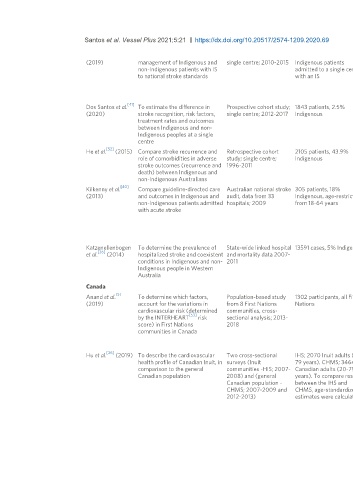
                              (2019)            management of Indigenous and   single centre; 2010-2015  Indigenous patients   Indigenous patients with stroke were 15.8 years younger   have a higher prevalence of
                                                non-Indigenous patients with IS                     admitted to a single centre  (56.8 years vs. 72.6 years, P < 0.001), and were more likely  preventable disease, including those
                                                to national stroke standards                        with an IS                to have risk factors for stroke, including smoking (51.2% vs.  that confer a higher stroke risk
                                                                                                                              15.0 %, P < 0.001), diabetes mellitus (37.2% vs. 16.8%, P =
                                                                                                                              0.003) and past history of CVA or TIA (50.2% vs. 31.1%, P
                                                                                                                              = 0.032)
                                            [41]
                              Dos Santos et al.    To estimate the difference in   Prospective cohort study;  1843 patients, 2.5%   Indigenous patients were younger (62 years vs. 74 years),  Indigenous Australians with stroke are
                              (2020)            stroke recognition, risk factors,   single centre; 2012-2017  Indigenous      and more likely to have diabetes (RD: 22.3% [95%CI: 3%,  a decade younger and have a higher
                                                treatment rates and outcomes                                                  41.7%]), dyslipidaemia (RD: 19.4% [95%CI: 21.%,    prevalence of important, modifiable
                                                between Indigenous and non-                                                   36.7%]), and have ever smoked (RD: 24.9% [95%CI:   stroke risk factors
                                                Indigenous peoples at a single                                                9.5%, 40.3%])
                                                centre
                                     [52]
                              He et al.   (2015) Compare stroke recurrence and   Retrospective cohort   2105 patients, 43.9%   In multivariable analyses, adjusting for comorbidities   Some of the excess risk of death
                                                role of comorbidities in adverse   study; single centre;   Indigenous         Indigenous patients’ excess risk for both case fatality (OR:  following a stroke was attributable to a
                                                stroke outcomes (recurrence and  1996-2011                                    1.25, 0.88-1.78) and long-term death (HR: 1.27, 1.01-1.61)   greater prevalence of comorbidities
                                                death) between Indigenous and                                                 was considerably reduced (when compared to unadjusted
                                                non-Indigenous Australians                                                    analyses
                                          [40]
                              Kilkenny et al.     Compare guideline-directed care  Australian national stroke  305 patients, 18%   Smoking, diabetes mellitus and excessive alcohol   Indigenous patients with stroke had
                              (2013)            and outcomes in Indigenous and   audit, data from 33   Indigenous, age-restricted   consumption were greater in Indigenous patients admitted  worse health outcomes even after
                                                non-Indigenous patients admitted  hospitals; 2009   from 18-64 years          to hospital with stroke than in non-Indigenous patients  adjusting for hospital site, age, risk
                                                with acute stroke                                                                                                                factors (diabetes mellitus, smoking,
                                                                                                                                                                                 alcohol), stroke severity variables
                                                                                                                                                                                 (speech impairment, incontinent
                                                                                                                                                                                 within 72 h), stroke subtype, and
                                                                                                                                                                                 access to a stroke unit
                              Katzenellenbogen  To determine the prevalence of   State-wide linked hospital  13591 cases, 5% Indigenous Indigenous stroke survivors aged less than 70 years had a   Whilst primary prevention can reduce
                                  [36]
                              et al.   (2014)   hospitalized stroke and coexistent  and mortality data 2007-                  greater comorbidity burden than non-Indigenous patients   disparities in incidence and prevalence,
                                                conditions in Indigenous and non- 2011                                        of the same age                                    the wider solutions lie in tackling
                                                Indigenous people in Western                                                                                                     environmental, social and economic
                                                Australia                                                                                                                        disadvantage

                              Canada
                                        [5]
                              Anand et al.      To determine which factors,   Population-based study   1302 participants, all First   More than 85% of individuals had a risk score in the   Communities with greater
                              (2019)            account for the variations in   from 8 First Nations   Nations                moderate to high range                             socioeconomic advantage (greater
                                                cardiovascular risk (determined   communities, cross-                                                                            employment, higher income and long-
                                                                 [53]
                                                by the INTERHEART   risk     sectional analysis; 2013-                                                                           term marital partnerships), greater
                                                score) in First Nations      2018                                                                                                trust between community members,
                                                communities in Canada                                                                                                            higher education levels and supportive
                                                                                                                                                                                 environments had a lesser burden of
                                                                                                                                                                                 cardiovascular risk factors
                                     [26]
                              Hu et al.   (2019) To describe the cardiovascular   Two cross-sectional   IHS; 2070 Inuit adults (20-  Inuit females had greater prevalence of heart attack (3.1%  Canadian Inuit, in comparison to the
                                                health profile of Canadian Inuit, in  surveys (Inuit   79 years). CHMS; 3464   vs. 1.8%), stroke (2.2% vs. 1.0%), diabetes (14.6% vs.   general Canadian population, have
                                                comparison to the general    communities -HIS; 2007- Canadian adults (20-79   9.0%), obesity (35.8% vs. 24.2%), HTN (7.5% vs. 2.5%)   different health profiles and a greater
                                                Canadian population          2008) and (general     years). To compare results   than non-Inuit females                          burden of cardiovascular diseases
                                                                             Canadian population -  between the IHS and       Inuit males had a higher prevalence of stroke (2.1% vs.
                                                                             CHMS; 2007-2009 and    CHMS, age-standardized    0.8%) and HTN (12.2% vs. 2.5%) than non-Inuit males
                                                                             2012-2013)             estimates were calculated  Inuit males and females had better blood lipid profile than

