


Page 54 - Read Online
P. 54
Inoue et al. Vessel Plus 2021;5:11  I  http://dx.doi.org/10.20517/2574-1209.2020.99                                                Page 7 of 10


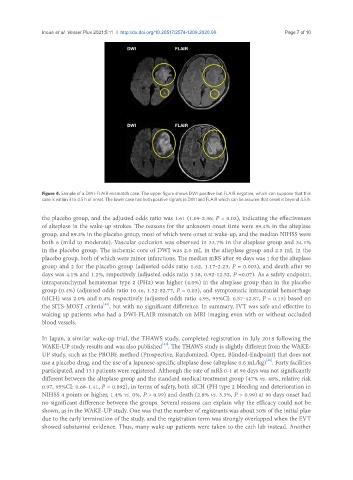
               Figure 4. Sample of a DWI-FLAIR mismatch case. The upper figure shows DWI positive but FLAIR negative, which can suppose that this
               case is within 3 to 4.5 h of onset. The lower case has both positive signals in DWI and FLAIR which can be assume that onset is beyond 4.5 h.


               the placebo group, and the adjusted odds ratio was 1.61 (1.09-2.36; P = 0.02), indicating the effectiveness
               of alteplase in the wake-up strokes. The reasons for the unknown onset time were 89.4% in the alteplase
               group, and 89.2% in the placebo group, most of which were onset at wake-up, and the median NIHSS were
               both 6 (mild to moderate). Vascular occlusion was observed in 33.7% in the alteplase group and 34.1%
               in the placebo group. The ischemic core of DWI was 2.0 mL in the alteplase group and 2.5 mL in the
               placebo group, both of which were minor infarctions. The median mRS after 90 days was 1 for the alteplase
               group and 2 for the placebo group (adjusted odds ratio 1.62, 1.17-2.23, P = 0.003), and death after 90
               days was 4.1% and 1.2%, respectively (adjusted odds ratio 3.38, 0.92-12.52, P =0.07). As a safety endpoint,
               intraparenchymal hematomas type 2 (PH2) was higher (4.0%) in the alteplase group than in the placebo
               group (0.4%) (adjusted odds ratio 10.46, 1.32-82.77, P = 0.03), and symptomatic intracranial hemorrhage
               (sICH) was 2.0% and 0.4% respectively (adjusted odds ratio 4.95, 95%CI: 0.57-42.87, P = 0.15) based on
                                    [43]
               the SITS-MOST criteria , but with no significant difference. In summary, IVT was safe and effective in
               waking up patients who had a DWI-FLAIR mismatch on MRI imaging even with or without occluded
               blood vessels.

               In Japan, a similar wake-up trial, the THAWS study, completed registration in July 2018 following the
                                                        [44]
               WAKE-UP study results and was also published . The THAWS study is slightly different from the WAKE-
               UP study, such as the PROBE method (Prospective, Randomized, Open, Blinded-Endpoint) that does not
                                                                                           [45]
               use a placebo drug, and the use of a Japanese-specific alteplase dose (alteplase 0.6 mL/kg) . Forty facilities
               participated, and 131 patients were registered. Although the rate of mRS 0-1 at 90 days was not significantly
               different between the alteplase group and the standard medical treatment group (47% vs. 48%, relative risk
               0.97, 95%CI: 0.68-1.41, P = 0.892), in terms of safety, both sICH (PH type 2 bleeding and deterioration in
               NIHSS 4 points or higher, 1.4% vs. 0%, P > 0.99) and death (2.8% vs. 3.3%, P > 0.99) at 90 days onset had
               no significant difference between the groups. Several reasons can explain why the efficacy could not be
               shown, as in the WAKE-UP study. One was that the number of registrants was about 50% of the initial plan
               due to the early termination of the study, and the registration term was strongly overlapped when the EVT
               showed substantial evidence. Thus, many wake-up patients were taken to the cath lab instead. Another

