


Page 118 - Read Online
P. 118
Page 8 of 14                 Edwards et al. Vessel Plus 2021;5:42  https://dx.doi.org/10.20517/2574-1209.2021.18


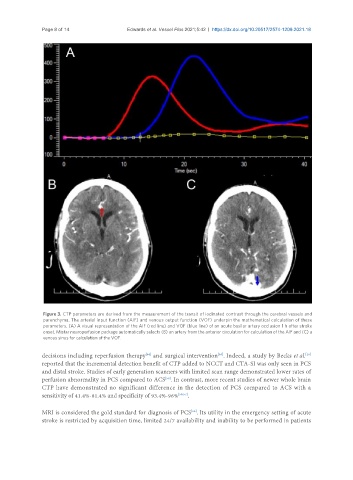
                Figure 3. CTP parameters are derived from the measurement of the transit of iodinated contrast through the cerebral vessels and
                parenchyma. The arterial input function (AIF) and venous output function (VOF) underpin the mathematical calculation of these
                parameters. (A) A visual representation of the AIF (red line) and VOF (blue line) of an acute basilar artery occlusion 1 h after stroke
                onset. Mistar neuroperfusion package automatically selects (B) an artery from the anterior circulation for calculation of the AIF and (C) a
                venous sinus for calculation of the VOF.

                                                                                                        [16]
               decisions including reperfusion therapy  and surgical intervention . Indeed, a study by Becks et al.
                                                  [64]
                                                                          [65]
               reported that the incremental detection benefit of CTP added to NCCT and CTA-SI was only seen in PCS
               and distal stroke. Studies of early generation scanners with limited scan range demonstrated lower rates of
               perfusion abnormality in PCS compared to ACS . In contrast, more recent studies of newer whole brain
                                                         [59]
               CTP have demonstrated no significant difference in the detection of PCS compared to ACS with a
               sensitivity of 41.4%-81.4% and specificity of 93.4%-96% [56,57] .

               MRI is considered the gold standard for diagnosis of PCS . Its utility in the emergency setting of acute
                                                                 [66]
               stroke is restricted by acquisition time, limited 24/7 availability and inability to be performed in patients

