


Page 36 - Read Online
P. 36
Buia et al. Vessel Plus 2022;6:48  https://dx.doi.org/10.20517/2574-1209.2022.04  Page 5 of 9


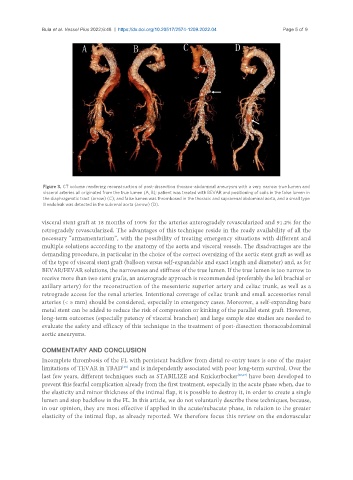
                Figure 3. CT volume rendering reconstruction of post-dissection thoraco-abdominal aneurysm with a very narrow true lumen and
                visceral arteries all originated from the true lumen (A, B); patient was treated with BEVAR and positioning of coils in the false lumen in
                the diaphragmatic tract (arrow) (C); and false lumen was thrombosed in the thoracic and suprarenal abdominal aorta, and a small type
                II endoleak was detected in the subrenal aorta (arrow) (D).

               visceral stent graft at 18 months of 100% for the arteries anterogradely revascularized and 91.2% for the
               retrogradely revascularized. The advantages of this technique reside in the ready availability of all the
               necessary “armamentarium”, with the possibility of treating emergency situations with different and
               multiple solutions according to the anatomy of the aorta and visceral vessels. The disadvantages are the
               demanding procedure, in particular in the choice of the correct oversizing of the aortic stent graft as well as
               of the type of visceral stent graft (balloon versus self-expandable and exact length and diameter) and, as for
               BEVAR/FEVAR solutions, the narrowness and stiffness of the true lumen. If the true lumen is too narrow to
               receive more than two stent grafts, an anterograde approach is recommended (preferably the left brachial or
               axillary artery) for the reconstruction of the mesenteric superior artery and celiac trunk, as well as a
               retrograde access for the renal arteries. Intentional coverage of celiac trunk and small accessories renal
               arteries (< 5 mm) should be considered, especially in emergency cases. Moreover, a self-expanding bare
               metal stent can be added to reduce the risk of compression or kinking of the parallel stent graft. However,
               long-term outcomes (especially patency of visceral branches) and large sample size studies are needed to
               evaluate the safety and efficacy of this technique in the treatment of post-dissection thoracoabdominal
               aortic aneurysms.

               COMMENTARY AND CONCLUSION
               Incomplete thrombosis of the FL with persistent backflow from distal re-entry tears is one of the major
               limitations of TEVAR in TBAD  and is independently associated with poor long-term survival. Over the
                                          [25]
               last few years, different techniques such as STABILIZE and Knickerbocker [26,27]  have been developed to
               prevent this fearful complication already from the first treatment, especially in the acute phase when, due to
               the elasticity and minor thickness of the intimal flap, it is possible to destroy it, in order to create a single
               lumen and stop backflow in the FL. In this article, we do not voluntarily describe these techniques, because,
               in our opinion, they are most effective if applied in the acute/subacute phase, in relation to the greater
               elasticity of the intimal flap, as already reported. We therefore focus this review on the endovascular

