


Page 34 - Read Online
P. 34
Buia et al. Vessel Plus 2022;6:48  https://dx.doi.org/10.20517/2574-1209.2022.04  Page 3 of 9


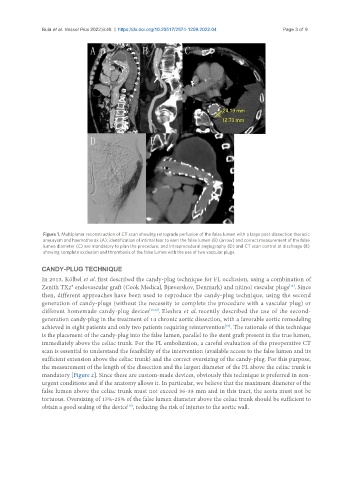
                Figure 1. Multiplanar reconstruction of CT scan showing retrograde perfusion of the false lumen with a large post-dissection thoracic
                aneurysm and haemothorax (A); identification of intimal tear to earn the false lumen (B) (arrow) and correct measurement of the false
                lumen diameter (C) are mandatory to plan the procedure; and intraprocedural angiography (D) and CT scan control at discharge (E)
                showing complete exclusion and thrombosis of the false lumen with the use of two vascular plugs.

               CANDY-PLUG TECHNIQUE
               In 2013, Kölbel et al. first described the candy-plug technique for FL occlusion, using a combination of
               Zenith TX2® endovascular graft (Cook Medical, Bjæverskov, Denmark) and nitinol vascular plugs . Since
                                                                                                  [14]
               then, different approaches have been used to reproduce the candy-plug technique, using the second
               generation of candy-plugs (without the necessity to complete the procedure with a vascular plug) or
               different homemade candy-plug devices [15,16] . Eleshra et al. recently described the use of the second-
               generation candy-plug in the treatment of 14 chronic aortic dissection, with a favorable aortic remodeling
               achieved in eight patients and only two patients requiring reintervention . The rationale of this technique
                                                                             [17]
               is the placement of the candy-plug into the false lumen, parallel to the stent graft present in the true lumen,
               immediately above the celiac trunk. For the FL embolization, a careful evaluation of the preoperative CT
               scan is essential to understand the feasibility of the intervention (available access to the false lumen and its
               sufficient extension above the celiac trunk) and the correct oversizing of the candy-plug. For this purpose,
               the measurement of the length of the dissection and the largest diameter of the FL above the celiac trunk is
               mandatory [Figure 2]. Since these are custom-made devices, obviously this technique is preferred in non-
               urgent conditions and if the anatomy allows it. In particular, we believe that the maximum diameter of the
               false lumen above the celiac trunk must not exceed 36-38 mm and in this tract, the aorta must not be
               tortuous. Oversizing of 15%-25% of the false lumen diameter above the celiac trunk should be sufficient to
               obtain a good sealing of the device , reducing the risk of injuries to the aortic wall.
                                            [18]

