


Page 35 - Read Online
P. 35
Page 4 of 9                     Buia et al. Vessel Plus 2022;6:48  https://dx.doi.org/10.20517/2574-1209.2022.04


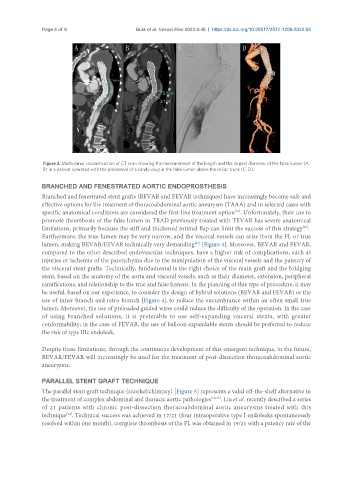
                Figure 2. Multiplanar reconstruction of CT scan showing the measurement of the length and the largest diameter of the false lumen (A,
                B) in a patient operated with the placement of a candy-plug in the false lumen above the celiac trunk (C, D).


               BRANCHED AND FENESTRATED AORTIC ENDOPROSTHESIS
               Branched and fenestrated stent grafts (BEVAR and FEVAR techniques) have increasingly become safe and
               effective options for the treatment of thoracoabdominal aortic aneurysm (TAAA) and in selected cases with
                                                                                [19]
               specific anatomical conditions are considered the first-line treatment option . Unfortunately, their use to
               promote thrombosis of the false lumen in TBAD previously treated with TEVAR has severe anatomical
               limitations, primarily because the stiff and thickened intimal flap can limit the success of this strategy .
                                                                                                       [20]
               Furthermore, the true lumen may be very narrow, and the visceral vessels can arise from the FL or true
               lumen, making BEVAR/FEVAR technically very demanding  [Figure 3]. Moreover, BEVAR and FEVAR,
                                                                   [21]
               compared to the other described endovascular techniques, have a higher risk of complications, such as
               injuries or ischemia of the parenchyma due to the manipulation of the visceral vessels and the patency of
               the visceral stent grafts. Technically, fundamental is the right choice of the main graft and the bridging
               stent, based on the anatomy of the aorta and visceral vessels, such as their diameter, extension, peripheral
               ramifications, and relationship to the true and false lumens. In the planning of this type of procedure, it may
               be useful, based on our experience, to consider the design of hybrid solutions (BEVAR and FEVAR) or the
               use of inner branch and retro branch [Figure 4], to reduce the encumbrance within an often small true
               lumen. Moreover, the use of preloaded guided wires could reduce the difficulty of the operation. In the case
               of  using  branched  solutions,  it  is  preferable  to  use  self-expanding  visceral  stents,  with  greater
               conformability; in the case of FEVAR, the use of balloon expandable stents should be preferred to reduce
               the risk of type IIIc endoleak.


               Despite these limitations, through the continuous development of this emergent technique, in the future,
               BEVAR/FEVAR will increasingly be used for the treatment of post-dissection thoracoabdominal aortic
               aneurysms.


               PARALLEL STENT GRAFT TECHNIQUE
               The parallel stent graft technique (snorkel/chimney) [Figure 5] represents a valid off-the-shelf alternative in
               the treatment of complex abdominal and thoracic aortic pathologies [22,23] . Liu et al. recently described a series
               of 21 patients with chronic post-dissection thoracoabdominal aortic aneurysms treated with this
               technique . Technical success was achieved in 17/21 (four intraoperative type I endoleaks spontaneously
                       [24]
               resolved within one month), complete thrombosis of the FL was obtained in 19/21 with a patency rate of the

