


Page 9 - Read Online
P. 9
Onea et al. Vessel Plus 2023;7:13  https://dx.doi.org/10.20517/2574-1209.2023.11  Page 3 of 12

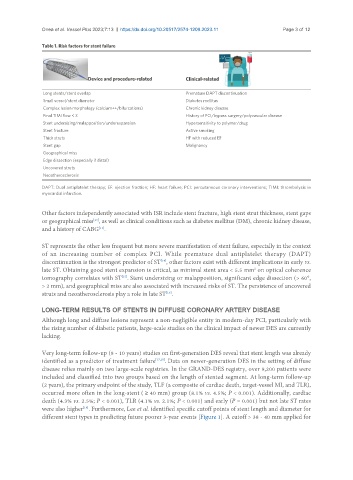
               Table 1. Risk factors for stent failure


                               Device and procedure-related     Clinical-related

                Long stents/stent overlap                       Premature DAPT discontinuation
                Small vessel/stent diameter                     Diabetes mellitus
                Complex lesion morphology (calcium++/bifurcations)  Chronic kidney disease
                Final TIMI flow < 3                             History of PCI/bypass surgery/polyvascular disease
                Stent undersizing/malapposition/underexpansion  Hypersensitivity to polymer/drug
                Stent fracture                                  Active smoking
                Thick struts                                    HF with reduced EF
                Stent gap                                       Malignancy
                Geographical miss
                Edge dissection (especially if distal)
                Uncovered struts
                Neoatherosclerosis

               DAPT: Dual antiplatelet therapy; EF: ejection fraction; HF: heart failure; PCI: percutaneous coronary interventions; TIMI: thrombolysis in
               myocardial infarction.


               Other factors independently associated with ISR include stent fracture, high stent strut thickness, stent gaps
                                [13]
               or geographical miss , as well as clinical conditions such as diabetes mellitus (DM), chronic kidney disease,
                                  [11]
               and a history of CABG .
               ST represents the other less frequent but more severe manifestation of stent failure, especially in the context
               of  an  increasing  number  of  complex  PCI.  While  premature  dual  antiplatelet  therapy  (DAPT)
               discontinuation is the strongest predictor of ST , other factors exist with different implications in early vs.
                                                       [14]
               late ST. Obtaining good stent expansion is critical, as minimal stent area < 5.5 mm  on optical coherence
                                                                                       2
               tomography correlates with ST . Stent undersizing or malapposition, significant edge dissection (> 60°,
                                          [15]
               > 2 mm), and geographical miss are also associated with increased risks of ST. The persistence of uncovered
               struts and neoatherosclerosis play a role in late ST .
                                                         [16]

               LONG-TERM RESULTS OF STENTS IN DIFFUSE CORONARY ARTERY DISEASE
               Although long and diffuse lesions represent a non-negligible entity in modern-day PCI, particularly with
               the rising number of diabetic patients, large-scale studies on the clinical impact of newer DES are currently
               lacking.


               Very long-term follow-up (8 - 10 years) studies on first-generation DES reveal that stent length was already
               identified as a predictor of treatment failure [17,18] . Data on newer-generation DES in the setting of diffuse
               disease relies mainly on two large-scale registries. In the GRAND-DES registry, over 9,200 patients were
               included and classified into two groups based on the length of stented segment. At long-term follow-up
               (2 years), the primary endpoint of the study, TLF (a composite of cardiac death, target-vessel MI, and TLR),
               occurred more often in the long-stent ( ≥ 40 mm) group (8.1% vs. 4.5%; P < 0.001). Additionally, cardiac
               death (4.3% vs. 2.5%; P < 0.001), TLR (4.1% vs. 2.1%; P < 0.001) and early (P = 0.001) but not late ST rates
               were also higher . Furthermore, Lee et al. identified specific cutoff points of stent length and diameter for
                             [19]
               different stent types in predicting future poorer 3-year events [Figure 1]. A cutoff > 38 - 40 mm applied for

