


Page 12 - Read Online
P. 12
Page 6 of 12                   Onea et al. Vessel Plus 2023;7:13  https://dx.doi.org/10.20517/2574-1209.2023.11


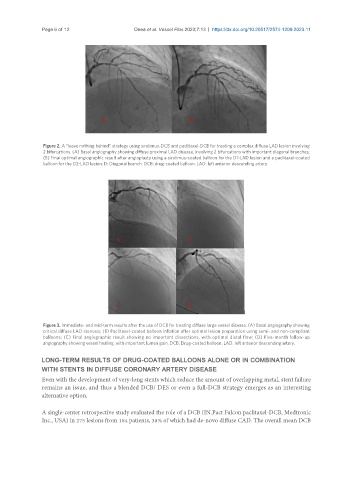
                Figure 2. A “leave nothing behind” strategy using sirolimus-DCB and paclitaxel-DCB for treating a complex diffuse LAD lesion involving
                2 bifurcations. (A) Basal angiography showing diffuse proximal LAD disease, involving 2 bifurcations with important diagonal branches;
                (B) Final optimal angiographic result after angioplasty using a sirolimus-coated balloon for the D1-LAD lesion and a paclitaxel-coated
                balloon for the D2-LAD lesion. D: Diagonal branch. DCB: drug-coated balloon. LAD: left anterior descending artery.


                Figure 3. Immediate- and mid-term results after the use of DCB for treating diffuse large vessel disease. (A) Basal angiography showing
                critical diffuse LAD stenosis; (B) Paclitaxel-coated balloon inflation after optimal lesion preparation using semi- and non-compliant
                balloons; (C) Final angiographic result showing no important dissections, with optimal distal flow; (D) Five-month follow-up
                angiography showing vessel healing, with important lumen gain. DCB: Drug-coated balloon. LAD: left anterior descending artery.

               LONG-TERM RESULTS OF DRUG-COATED BALLOONS ALONE OR IN COMBINATION
               WITH STENTS IN DIFFUSE CORONARY ARTERY DISEASE
               Even with the development of very-long stents which reduce the amount of overlapping metal, stent failure
               remains an issue, and thus a blended DCB/ DES or even a full-DCB strategy emerges as an interesting
               alternative option.


               A single-center retrospective study evaluated the role of a DCB (IN.Pact Falcon paclitaxel-DCB, Medtronic
               Inc., USA) in 275 lesions from 184 patients, 38% of which had de-novo diffuse CAD. The overall mean DCB

