


Page 10 - Read Online
P. 10
Page 4 of 12                   Onea et al. Vessel Plus 2023;7:13  https://dx.doi.org/10.20517/2574-1209.2023.11


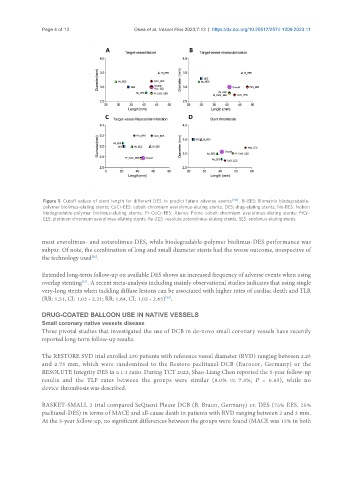
                Figure  1.  Cutoff  values  of  stent  length  for  different  DES  to  predict  future  adverse  events [20] .  Bi-BES: Biomatrix  biodegradable-
                polymer biolimus-eluting stents; CoCr-EES: cobalt-chromium everolimus-eluting stents; DES: drug-eluting stents; No-BES: Nobori
                biodegradable-polymer  biolimus-eluting  stents;  Pr-CoCr-EES:  Xience  Prime  cobalt-chromium  everolimus-eluting  stents;  PtCr-
                EES: platinum chromium everolimus-eluting stents; Re-ZES: resolute zotarolimus-eluting stents; SES: sirolimus-eluting stents.


               most everolimus- and zotarolimus-DES, while biodegradable-polymer biolimus-DES performance was
               subpar. Of note, the combination of long and small diameter stents had the worse outcome, irrespective of
                                [20]
               the technology used .
               Extended long-term follow-up on available DES shows an increased frequency of adverse events when using
               overlap stenting . A recent meta-analysis including mainly observational studies indicates that using single
                             [21]
               very-long stents when tackling diffuse lesions can be associated with higher rates of cardiac death and TLR
               (RR: 1.51, CI: 1.03 - 2.21; RR: 1.64, CI: 1.02 - 2.65) .
                                                         [22]

               DRUG-COATED BALLOON USE IN NATIVE VESSELS
               Small coronary native vessels disease
               Three pivotal studies that investigated the use of DCB in de-novo small coronary vessels have recently
               reported long-term follow-up results.


               The RESTORE SVD trial enrolled 230 patients with reference vessel diameter (RVD) ranging between 2.25
               and 2.75 mm, which were randomized to the Restore paclitaxel-DCB (Eurocor, Germany) or the
               RESOLUTE Integrity DES in a 1:1 ratio. During TCT 2022, Shao-Liang Chen reported the 5-year follow-up
               results  and  the  TLF  rates  between  the  groups  were  similar  (8.0%  vs. 7.3%;  P  =  0.85),  while  no
               device thrombosis was described.

               BASKET-SMALL 2 trial compared SeQuent Please DCB (B. Braun, Germany) vs. DES (75% EES, 25%
               paclitaxel-DES) in terms of MACE and all-cause death in patients with RVD ranging between 2 and 3 mm.
               At the 3-year follow-up, no significant differences between the groups were found (MACE was 15% in both

