


Page 15 - Read Online
P. 15
Onea et al. Vessel Plus 2023;7:13  https://dx.doi.org/10.20517/2574-1209.2023.11  Page 9 of 12


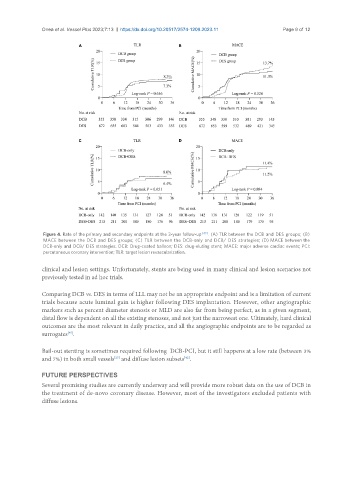
                Figure 4. Rate of the primary and secondary endpoints at the 3-year follow-up [42] . (A) TLR between the DCB  and  DES  groups;  (B)
                MACE  between  the  DCB  and  DES  groups;  (C)  TLR  between  the  DCB-only  and  DCB/  DES  strategies; (D) MACE between the
                DCB-only and DCB/ DES strategies. DCB: Drug-coated balloon; DES: drug-eluting stent; MACE: major adverse cardiac events; PCI:
                percutaneous coronary intervention; TLR: target lesion revascularization.

               clinical and lesion settings. Unfortunately, stents are being used in many clinical and lesion scenarios not
               previously tested in ad hoc trials.

               Comparing DCB vs. DES in terms of LLL may not be an appropriate endpoint and is a limitation of current
               trials because acute luminal gain is higher following DES implantation. However, other angiographic
               markers such as percent diameter stenosis or MLD are also far from being perfect, as in a given segment,
               distal flow is dependent on all the existing stenoses, and not just the narrowest one. Ultimately, hard clinical
               outcomes are the most relevant in daily practice, and all the angiographic endpoints are to be regarded as
                        [45]
               surrogates .
               Bail-out stenting is sometimes required following  DCB-PCI, but it still happens at a low rate (between 3%
                                        [25]
                                                               [42]
               and 7%) in both small vessels  and diffuse lesion subsets .
               FUTURE PERSPECTIVES
               Several promising studies are currently underway and will provide more robust data on the use of DCB in
               the treatment of de-novo coronary disease. However, most of the investigators excluded patients with
               diffuse lesions.

