


Page 73 - Read Online
P. 73
Barioli et al. Vessel Plus 2024;8:13  https://dx.doi.org/10.20517/2574-1209.2023.68   Page 11 of 14


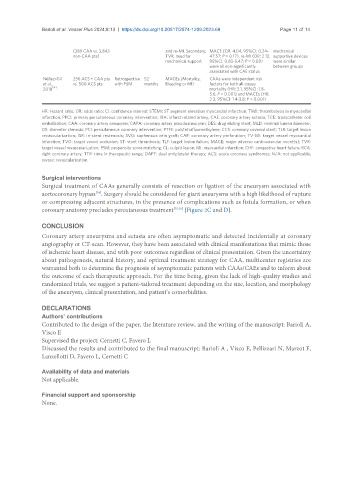
                          (389 CAA vs. 3,843             and re-MI. Secondary:  MACE (OR: 4.04, 95%CI: 0.34-  mechanical
                          non-CAA pts)                   TVR, need for   47.57; P = 0.17), re-MI (OR: 2.13,  supportive devices
                                                         mechanical support  95%CI: 0.83-5.47; P = 0.08)   were similar
                                                                        were all non-significantly   between groups
                                                                        associated with CAE status
                Núñez-Gil     256 ACS + CAA pts  Retrospective  52   MACEs (Mortality,   CAAs were independent risk
                et al.,   vs. 500 ACS pts  with PSM   months  Bleeding or MI)  factors for both all-cause
                   [4]
                2018                                                    mortality (HR: 3.1, 95%CI: 1.8-
                                                                        5.6; P < 0.001) and MACEs (HR:
                                                                        2.3, 95%CI: 1.4-3.8; P < 0.001)
               HR: Hazard ratio; OR: odds ratio; CI: confidence interval; STEMI: ST segment elevation myocardial infarction; TIMI: thrombolysis in myocardial
               infarction; PPCI: primary percutaneous coronary intervention; IRA: infarct related artery; CAE: coronary artery ectasia; TCE: transcatheter coil
               embolization; CAA: coronary artery aneurysm; CAPA: coronary artery pseudoaneurysm; DES: drug eluting stent; MLD: minimal lumen diameter;
               DS: diameter stenosis; PCI: percutaneous coronary intervention; PTFE: polytetrafluoroethylene; CCS: coronary covered stent; TLR: target lesion
               revascularization; ISR: in-stent restenosis; SVG: saphenous vein graft; CAP: coronary artery perforation; TV-MI: target vessel myocardial
               infarction; TVO: target vessel occlusion; ST: stent thrombosis; TLF: target lesion failure; MACE: major adverse cardiovascular event(s); TVR:
               target vessel revascularization; PSM: propensity score matching; CL: culprit lesion; MI: myocardial infarction; CHF: congestive heart failure; RCA:
               right coronary artery; TTR: time in therapeutic range; DAPT: dual antiplatelet therapy; ACS: acute coronary syndromes; N/A: not applicable;
               revasc: revascularization.


               Surgical interventions
               Surgical treatment of CAAs generally consists of resection or ligation of the aneurysm associated with
               aortocoronary bypass . Surgery should be considered for giant aneurysms with a high likelihood of rupture
                                 [74]
               or compressing adjacent structures, in the presence of complications such as fistula formation, or when
               coronary anatomy precludes percutaneous treatment [75,76]  [Figure 2C and D].


               CONCLUSION
               Coronary artery aneurysms and ectasia are often asymptomatic and detected incidentally at coronary
               angiography or CT-scan. However, they have been associated with clinical manifestations that mimic those
               of ischemic heart disease, and with poor outcomes regardless of clinical presentation. Given the uncertainty
               about pathogenesis, natural history, and optimal treatment strategy for CAA, multicenter registries are
               warranted both to determine the prognosis of asymptomatic patients with CAAs/CAEs and to inform about
               the outcome of each therapeutic approach. For the time being, given the lack of high-quality studies and
               randomized trials, we suggest a patient-tailored treatment depending on the size, location, and morphology
               of the aneurysm, clinical presentation, and patient’s comorbidities.

               DECLARATIONS
               Authors’ contributions
               Contributed to the design of the paper, the literature review, and the writing of the manuscript: Barioli A,
               Visco E
               Supervised the project: Cernetti C, Favero L
               Discussed the results and contributed to the final manuscript: Barioli A , Visco E, Pellizzari N, Marzot F,
               Lanzellotti D, Favero L, Cernetti C


               Availability of data and materials
               Not applicable.


               Financial support and sponsorship
               None.

