


Page 122 - Read Online
P. 122
Page 4 of 15 Cheng et al. Soft Sci. 2026, 6, 36
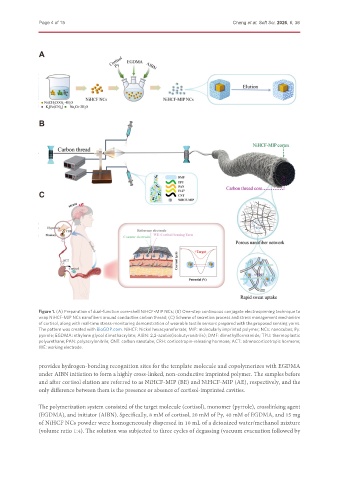
Figure 1. (A) Preparation of dual-function core-shell NiHCF-MIP NCs; (B) One-step continuous conjugate electrospinning technique to
wrap NiHCF-MIP NCs nanofibers around conductive carbon thread; (C) Scheme of secretion process and stress management mechanism
of cortisol, along with real-time stress-monitoring demonstration of wearable textile sensors prepared with the proposed sensing yarns.
The pattern was created with BioGDP.com. NiHCF: Nickel hexacyanoferrate; MIP: molecularly imprinted polymer; NCs: nanocubes; Py:
pyrrole; EGDMA: ethylene glycol dimethacrylate; AIBN: 2,2-azobis(isobutyronitrile); DMF: dimethylformamide; TPU: thermoplastic
polyurethane; PAN: polyacrylonitrile; CNT: carbon nanotube; CRH: corticotropin-releasing hormone; ACT: adrenocorticotropic hormone;
WE: working electrode.
provides hydrogen-bonding recognition sites for the template molecule and copolymerizes with EGDMA
under AIBN initiation to form a highly cross-linked, non-conductive imprinted polymer. The samples before
and after cortisol elution are referred to as NiHCF-MIP (BE) and NiHCF-MIP (AE), respectively, and the
only difference between them is the presence or absence of cortisol-imprinted cavities.
The polymerization system consisted of the target molecule (cortisol), monomer (pyrrole), crosslinking agent
(EGDMA), and initiator (AIBN). Specifically, 8 mM of cortisol, 20 mM of Py, 40 mM of EGDMA, and 15 mg
of NiHCF NCs powder were homogeneously dispersed in 10 mL of a deionized water/methanol mixture
(volume ratio 1:4). The solution was subjected to three cycles of degassing (vacuum evacuation followed by

