


Page 89 - Read Online
P. 89
Chen et al. Soft Sci. 2026, 6, 9                                                 Page 27 of 36


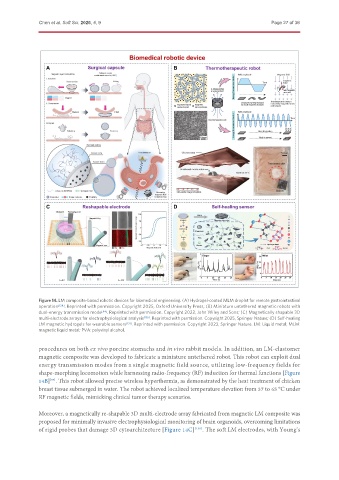
               Figure 14. LM composite-based robotic devices for biomedical engineering. (A) Hydrogel-coated MLM droplet for remote gastrointestinal
               operation [129] . Reprinted with permission. Copyright 2025, Oxford University Press; (B) Miniature untethered magnetic robots with
               dual-energy transmission mode  [94] . Reprinted with permission. Copyright 2022, John Wiley and Sons; (C) Magnetically shapable 3D
               multi-electrode arrays for electrophysiological analysis [130] . Reprinted with permission. Copyright 2025, Springer Nature; (D) Self-healing
               LM magnetic hydrogels for wearable sensors [131] . Reprinted with permission. Copyright 2023, Springer Nature. LM: Liquid metal; MLM:
               magnetic liquid metal; PVA: polyvinyl alcohol.

               procedures on both ex vivo porcine stomachs and in vivo rabbit models. In addition, an LM-elastomer
               magnetic composite was developed to fabricate a miniature untethered robot. This robot can exploit dual
               energy transmission modes from a single magnetic field source, utilizing low-frequency fields for
               shape-morphing locomotion while harnessing radio-frequency (RF) induction for thermal functions [Figure
               14B] . This robot allowed precise wireless hyperthermia, as demonstrated by the heat treatment of chicken
                   [94]
               breast tissue submerged in water. The robot achieved localized temperature elevation from 37 to 65 °C under
               RF magnetic fields, mimicking clinical tumor therapy scenarios.


               Moreover, a magnetically re-shapable 3D multi-electrode array fabricated from magnetic LM composite was
               proposed for minimally invasive electrophysiological monitoring of brain organoids, overcoming limitations
               of rigid probes that damage 3D cytoarchitecture [Figure 14C] [130] . The soft LM electrodes, with Young’s

