


Page 91 - Read Online
P. 91
Chen et al. Soft Sci. 2026, 6, 9                                                 Page 29 of 36


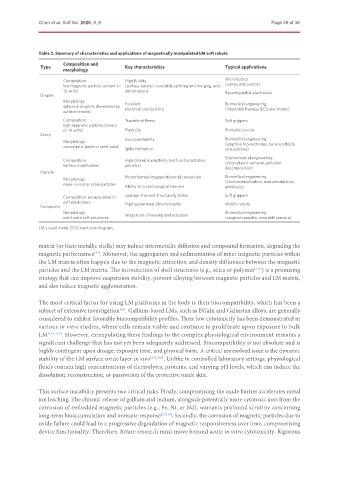
               Table 2. Summary of characteristics and applications of magnetically manipulated LM soft robots
                       Composition and
               Type                          Key characteristics                Typical applications
                       morphology
                       Composition:          High fluidity                      Microfluidics
                       low magnetic particle content (< (surface tension, reversible splitting and merging, and  (valves and pumps)
                       10 wt%)               deformation)                       Reconfigurable electronics
               Droplet
                       Morphology:
                       spherical droplets dominated by  Excellent               Biomedical engineering
                       surface tension       electrical conductivity            (injectable therapy, ECG electrodes)
                       Composition:          Tunable stiffness                  Soft grippers
                       high magnetic particle content
                       (> 10 wt%)            Plasticity                         Printable circuits
               Slurry
                                             Good printability                  Biomedical engineering
                       Morphology:                                              (adaptive bioelectrodes, bone scaffolds,
                       viscoelastic paste or semi-solid  Spike formation        skin patches)
                                                                                Environmental engineering
                       Composition:          High chemical reactivity and functionalization  (microplastic removal, pollutant
                       surface modification  potential
                                                                                decomposition)
               Particle
                                             Photothermal/magnetothermal conversion  Biomedical engineering
                       Morphology:                                              (chemoembolization, neuromodulation,
                       nano- or micro-scale particles  Ability to cross biological barriers  antibiosis)
                       Composition: encapsulated in  Leakage-free and structurally stable  Soft grippers
                       soft elastomers       High operational dimensionality    Mobile robots
               Composite
                       Morphology:                                              Biomedical engineering
                       solid-state soft structures  Integration of sensing and actuation  (surgical capsules, wearable sensors)
               LM: Liquid metal; ECG: electrocardiogram.


               matrix (or their metallic shells) may induce intermetallic diffusion and compound formation, degrading the
               magnetic performance . Moreover, the aggregation and sedimentation of inner magnetic particles within
                                  [74]
               the LM matrix often happen due to the magnetic attraction and density difference between the magnetic
               particles and the LM matrix. The introduction of shell structures (e.g., silica or polymer [132] ) is a promising
               strategy that can improve suspension stability, prevent alloying between magnetic particles and LM matrix,
               and also reduce magnetic agglomeration.

               The most critical factor for using LM platforms in the body is their biocompatibility, which has been a
               subject of extensive investigation . Gallium-based LMs, such as EGaIn and Galinstan alloys, are generally
                                           [32]
               considered to exhibit favorable biocompatibility profiles. Their low cytotoxicity has been demonstrated in
               various in vitro studies, where cells remain viable and continue to proliferate upon exposure to bulk
               LM [133,134] . However, extrapolating these findings to the complex physiological environment remains a
               significant challenge that has not yet been adequately addressed. Biocompatibility is not absolute and is
               highly contingent upon dosage, exposure time, and physical form. A critical unresolved issue is the dynamic
               stability of the LM surface oxide layer in vivo [135,136] . Unlike in controlled laboratory settings, physiological
               fluids contain high concentrations of electrolytes, proteins, and varying pH levels, which can induce the
               dissolution, reconstruction, or passivation of the protective oxide skin.


               This surface instability presents two critical risks. Firstly, compromising the oxide barrier accelerates metal
               ion leaching. The chronic release of gallium and indium, alongside potentially more cytotoxic ions from the
               corrosion of embedded magnetic particles (e.g., Fe, Ni, or Nd), warrants profound scrutiny concerning
               long-term bioaccumulation and immune response [33,136] . Secondly, the corrosion of magnetic particles due to
               oxide failure could lead to a progressive degradation of magnetic responsiveness over time, compromising
               device functionality. Therefore, future research must move beyond acute in vitro cytotoxicity. Rigorous

