


Page 108 - Read Online
P. 108
Hao et al. Soft Sci. 2025, 5, 39  https://dx.doi.org/10.20517/ss.2025.48         Page 7 of 25

                                                                 [72]
               which a spinel phase is dispersed within a rock salt matrix . By leveraging the significant polarization loss
               inherent to high-entropy oxides and the spatial distribution of functional units, the resulting composite
                                                                            [72]
               demonstrates outstanding electromagnetic wave absorption performance .

               Microwave absorption mechanisms of mesoscopic metacomposites
               Dielectric materials primarily exhibit the polarization response and conduction response when subjected to
               electromagnetic fields. The permittivity (ε  = ε ’ - jε ’’) characterizes the response behavior of dielectric
                                                        r
                                                            r
                                                    r
               materials in electromagnetic fields. The real part of the permittivity indicates the ability to store
               electromagnetic energy, while the imaginary part reflects the capacity to dissipate electromagnetic energy .
                                                                                                        [73]
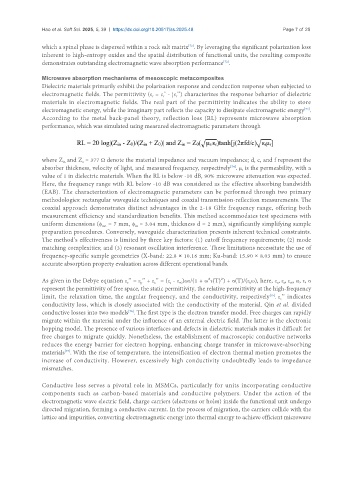
               According to the metal back-panel theory, reflection loss (RL) represents microwave absorption
               performance, which was simulated using measured electromagnetic parameters through


               where Z  and Z  = 377 Ω denote the material impedance and vacuum impedance; d, c, and f represent the
                      in
                             0
               absorber thickness, velocity of light, and measured frequency, respectively . μ  is the permeability, with a
                                                                               [74]
                                                                                   r
               value of 1 in dielectric materials. When the RL is below -10 dB, 90% microwave attenuation was expected.
               Here, the frequency range with RL below -10 dB was considered as the effective absorbing bandwidth
               (EAB). The characterization of electromagnetic parameters can be performed through two primary
               methodologies: rectangular waveguide techniques and coaxial transmission-reflection measurements. The
               coaxial approach demonstrates distinct advantages in the 2-18 GHz frequency range, offering both
               measurement efficiency and standardization benefits. This method accommodates test specimens with
               uniform dimensions (ϕ  = 7 mm, ϕ  = 3.04 mm, thickness d = 2 mm), significantly simplifying sample
                                               in
                                   out
               preparation procedures. Conversely, waveguide characterization presents inherent technical constraints.
               The method’s effectiveness is limited by three key factors: (1) cutoff frequency requirements; (2) mode
               matching complexities; and (3) resonant oscillation interference. These limitations necessitate the use of
               frequency-specific sample geometries (X-band: 22.8 × 10.16 mm; Ku-band: 15.90 × 8.03 mm) to ensure
               accurate absorption property evaluation across different operational bands.


               As given in the Debye equation ε ’’ = ε ’’ + ε ’’ = (ε  - ε )ωτ/(1 + ω²τ(T)²) + σ(T)/(ε ω), here, ε , ε , ε , ω, τ, σ
                                            r
                                                          s
                                                p
                                                     c
                                                                                              0
                                                                                                 s
                                                                                     0
                                                                                                   ∞
                                                             ∞
               represent the permittivity of free space, the static permittivity, the relative permittivity at the high-frequency
                                                                                            [75]
               limit, the relaxation time, the angular frequency, and the conductivity, respectively . ε ’’ indicates
                                                                                               c
               conductivity loss, which is closely associated with the conductivity of the material. Qin et al. divided
               conductive losses into two models . The first type is the electron transfer model. Free charges can rapidly
                                            [76]
               migrate within the material under the influence of an external electric field. The latter is the electronic
               hopping model. The presence of various interfaces and defects in dielectric materials makes it difficult for
               free charges to migrate quickly. Nonetheless, the establishment of macroscopic conductive networks
               reduces the energy barrier for electron hopping, enhancing charge transfer in microwave-absorbing
               materials . With the rise of temperature, the intensification of electron thermal motion promotes the
                       [77]
               increase of conductivity. However, excessively high conductivity undoubtedly leads to impedance
               mismatches.
               Conductive loss serves a pivotal role in MSMCs, particularly for units incorporating conductive
               components such as carbon-based materials and conductive polymers. Under the action of the
               electromagnetic wave electric field, charge carriers (electrons or holes) inside the functional unit undergo
               directed migration, forming a conductive current. In the process of migration, the carriers collide with the
               lattice and impurities, converting electromagnetic energy into thermal energy to achieve efficient microwave

