


Page 131 - Read Online
P. 131
Page 8 of 26                            Sun et al. Soft Sci. 2025, 5, 18  https://dx.doi.org/10.20517/ss.2024.77


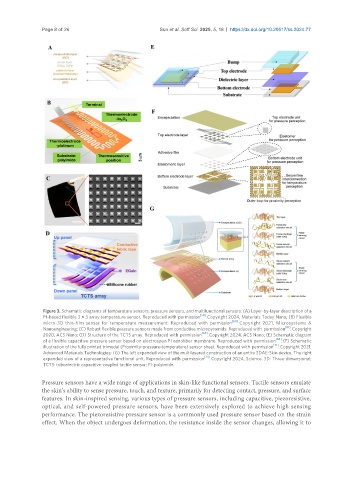
                Figure 3. Schematic diagrams of temperature sensors, pressure sensors, and multifunctional sensors. (A) Layer-by-layer description of a
                Pt-based flexible 3 × 3 array temperature sensor. Reproduced with permission [58] . Copyright 2024, Materials Today Nano; (B) Flexible
                micro-3D  thin-film  sensor  for  temperature  measurement.  Reproduced  with  permission [60] . Copyright  2021,  Microsystems  &
                Nanoengineering; (C) Robust flexible pressure sensors made from conductive micropyramids. Reproduced with permission [61] . Copyright
                2020, ACS Nano; (D) Structure of the TCTS array. Reproduced with permission [64] . Copyright 2024, ACS Nano; (E) Schematic diagram
                of a flexible capacitive pressure sensor based on electrospun PI nanofiber membrane. Reproduced with  permission [68] ; (F) Schematic
                                                                                             [71]
                illustration of the fully printed trimodal (Proximity-pressure-temperature) sensor sheet. Reproduced with permission  . Copyright 2021,
                Advanced Materials Technologies; (G) The left expanded view of the multilayered construction of an entire 3DAE-Skin device. The right
                                                                      [73]
                expanded view of a representative functional unit. Reproduced with  permission  . Copyright 2024, Science. 3D: Three-dimensional;
                TCTS: triboelectric capacitive-coupled tactile sensor; PI: polyimide.

               Pressure sensors have a wide range of applications in skin-like functional sensors. Tactile sensors emulate
               the skin’s ability to sense pressure, touch, and texture, primarily for detecting contact, pressure, and surface
               features. In skin-inspired sensing, various types of pressure sensors, including capacitive, piezoresistive,
               optical, and self-powered pressure sensors, have been extensively explored to achieve high sensing
               performance. The piezoresistive pressure sensor is a commonly used pressure sensor based on the strain
               effect. When the object undergoes deformation, the resistance inside the sensor changes, allowing it to

