


Page 129 - Read Online
P. 129
Page 6 of 26                            Sun et al. Soft Sci. 2025, 5, 18  https://dx.doi.org/10.20517/ss.2024.77


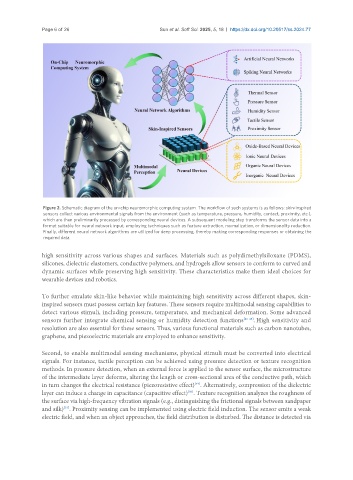
                Figure 2. Schematic diagram of the on-chip neuromorphic computing system. The workflow of such systems is as follows: skin-inspired
                sensors collect various environmental signals from the environment (such as temperature, pressure, humidity, contact, proximity, etc.),
                which are then preliminarily processed by corresponding neural devices. A subsequent modeling step transforms the sensor data into a
                format suitable for neural network input, employing techniques such as feature extraction, normalization, or dimensionality reduction.
                Finally, different neural network algorithms are utilized for deep processing, thereby making corresponding responses or obtaining the
                required data.

               high sensitivity across various shapes and surfaces. Materials such as polydimethylsiloxane (PDMS),
               silicones, dielectric elastomers, conductive polymers, and hydrogels allow sensors to conform to curved and
               dynamic surfaces while preserving high sensitivity. These characteristics make them ideal choices for
               wearable devices and robotics.


               To further emulate skin-like behavior while maintaining high sensitivity across different shapes, skin-
               inspired sensors must possess certain key features. These sensors require multimodal sensing capabilities to
               detect various stimuli, including pressure, temperature, and mechanical deformation. Some advanced
               sensors further integrate chemical sensing or humidity detection functions [45-48] . High sensitivity and
               resolution are also essential for these sensors. Thus, various functional materials such as carbon nanotubes,
               graphene, and piezoelectric materials are employed to enhance sensitivity.


               Second, to enable multimodal sensing mechanisms, physical stimuli must be converted into electrical
               signals. For instance, tactile perception can be achieved using pressure detection or texture recognition
               methods. In pressure detection, when an external force is applied to the sensor surface, the microstructure
               of the intermediate layer deforms, altering the length or cross-sectional area of the conductive path, which
               in turn changes the electrical resistance (piezoresistive effect) . Alternatively, compression of the dielectric
                                                                   [49]
                                                                [50]
               layer can induce a change in capacitance (capacitive effect) . Texture recognition analyzes the roughness of
               the surface via high-frequency vibration signals (e.g., distinguishing the frictional signals between sandpaper
                       [51]
               and silk) . Proximity sensing can be implemented using electric field induction. The sensor emits a weak
               electric field, and when an object approaches, the field distribution is disturbed. The distance is detected via

