


Page 50 - Read Online
P. 50
Page 18 of 26                           Wang et al. Soft Sci 2023;3:34  https://dx.doi.org/10.20517/ss.2023.25

               Table 4. Room-temperature TE properties of other inorganic TE materials
                                                                     S       σ       PF
                Materials                 Preparation method                               2   ZT    Ref.
                                                                     (μV/K)  (S/cm)  (μW/mK )
                Cu  Te NWs/PVDF           Mechanical Press, drop-coating  9.6  2,490  23       ~     [105]
                 1.75
                Cu Se NW/PVDF             Drop casting, cold pressing  14.16  5,578.2  111.84  ~0.04  [106]
                 2-x
                CuI/Nylon                 Wet-chemical process, hot pressing  600  0.09  3.03  ~     [107]
                Ag Te NWs                 Hydrothermal                -99.48  153.35  151.76   ~     [108]
                 2
                                          Room-temperature welding    -154.96  149.82  359.76  ~
                Ag Te NWs                 Hydrothermal,               -50.4  192.5   48.9      ~     [109]
                 x
                                          in situ chemical transformation,
                CNF/Bi Sb Te 3            Vacuum filtration           154    493     1,169.2   ~     [110]
                       1.5
                    0.5
                CNF/Bi Se Te 2.7                                      -130   532     899.08    ~
                      0.3
                    2
                Bi Te  and Sb Te  modified paper  Vacuum filtration   142    ~       ~         ~     [111]
                 2  3   2  3
                Se/Ag S                   Wet-chemical process, hot pressing  -81.4  743  492.6  > 0.26  [112]
                    2
               CNF: Cellulose nanofiber; NWs: nanowires; TE: thermoelectric; ZT: thermoelectric figure of merit; PF: PEDOT:PSS-functionalized; PVP:
               poly(vinylpyrrolidone); PVDF: polyvinylidene fluoride.


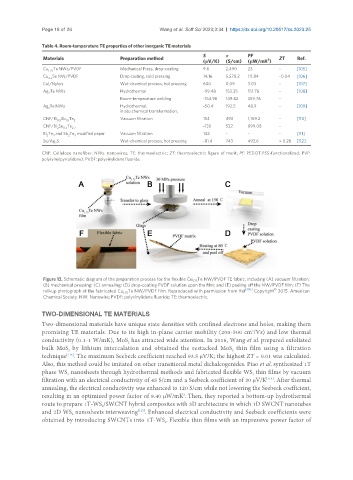
                Figure 13. Schematic diagram of the preparation process for the flexible Cu  Te NW/PVDF TE fabric, including (A) vacuum filtration;
                                                                  1.75
                (B) mechanical pressing; (C) annealing; (D) drop-coating PVDF solution upon the film; and (E) peeling off the NW/PVDF film; (F) The
                                                                                    [105]    ©
                roll-up photograph of the fabricated Cu  Te NW/PVDF film. Reproduced with permission from  Ref  . Copyright  2015. American
                                           1.75
                Chemical Society. NW: Nanowire; PVDF: polyvinylidene fluoride; TE: thermoelectric.
               TWO-DIMENSIONAL TE MATERIALS
               Two-dimensional materials have unique state densities with confined electrons and holes, making them
               promising TE materials. Due to its high in-plane carrier mobility (200-500 cm /Vs) and low thermal
                                                                                      2
               conductivity (0.1-1 W/mK), MoS  has attracted wide attention. In 2016, Wang et al. prepared exfoliated
                                            2
               bulk MoS  by lithium intercalation and obtained the restacked MoS  thin film using a filtration
                        2
                                                                               2
               technique . The maximum Seebeck coefficient reached 93.5 μV/K; the highest ZT = 0.01 was calculated.
                       [113]
               Also, this method could be imitated on other transitional metal dichalcogenides. Piao et al. synthesized 1T
               phase WS  nanosheets through hydrothermal methods and fabricated flexible WS  thin films by vacuum
                                                                                      2
                        2
                                                                                           [114]
               filtration with an electrical conductivity of 45 S/cm and a Seebeck coefficient of 30 μV/K . After thermal
               annealing, the electrical conductivity was enhanced to 120 S/cm while not lowering the Seebeck coefficient,
                                                               2
               resulting in an optimized power factor of 9.40 μW/mK . Then, they reported a bottom-up hydrothermal
               route to prepare 1T-WS /SWCNT hybrid composites with 3D architecture in which 1D SWCNT nanotubes
                                   2
               and 2D WS  nanosheets interweaving . Enhanced electrical conductivity and Seebeck coefficients were
                                               [115]
                         2
               obtained by introducing SWCNTs into 1T-WS . Flexible thin films with an impressive power factor of
                                                         2

