


Page 192 - Read Online
P. 192
Wu et al. Soft Sci 2023;3:35  https://dx.doi.org/10.20517/ss.2023.26             Page 7 of 12


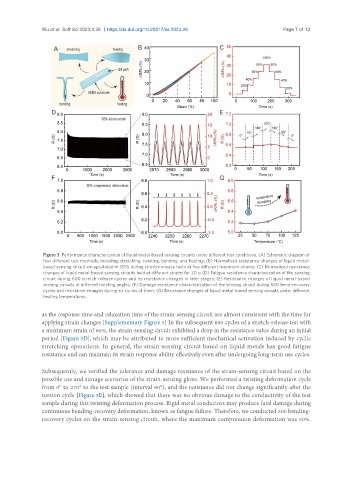
                Figure 3. Performance characterization of liquid metal-based sensing circuits under different test conditions. (A) Schematic diagram of
                four different test methods, including stretching, twisting, bending, and heating; (B) Normalized resistance changes of liquid metal-
                based sensing circuit encapsulated in SEBS during stretch-release tests at five different maximum strains; (C) Normalized resistance
                changes of liquid metal-based sensing circuits held at different strains for 30 s; (D) Fatigue resistance characterization of the sensing
                circuit during 600 stretch-release cycles and its resistance changes in later stages; (E) Resistance changes of liquid metal-based
                sensing circuits at different twisting angles; (F) Damage resistance characterization of the sensing circuit during 500 bend-recovery
                cycles and resistance changes during six cycles of them; (G) Resistance changes of liquid metal-based sensing circuits under different
                heating temperatures.

               as the response time and relaxation time of the strain-sensing circuit are almost consistent with the time for
               applying strain changes [Supplementary Figure 5] In the subsequent 600 cycles of a stretch-release test with
               a maximum strain of 60%, the strain-sensing circuit exhibited a drop in the resistance value during an initial
               period [Figure 3D], which may be attributed to more sufficient mechanical activation induced by cyclic
               stretching operations. In general, the strain-sensing circuit based on liquid metals has good fatigue
               resistance and can maintain its strain response ability effectively even after undergoing long-term use cycles.

               Subsequently, we verified the tolerance and damage resistance of the strain-sensing circuit based on the
               possible use and storage scenarios of the strain-sensing glove. We performed a twisting deformation cycle
               from 0° to 270° to the test sample (interval 90°), and the resistance did not change significantly after the
               torsion cycle [Figure 3E], which showed that there was no obvious damage to the conductivity of the test
               sample during this twisting deformation process. Rigid metal conductors may produce fatal damage during
               continuous bending-recovery deformation, known as fatigue failure. Therefore, we conducted 500 bending-
               recovery cycles on the strain-sensing circuit, where the maximum compression deformation was 50%.

