


Page 190 - Read Online
P. 190
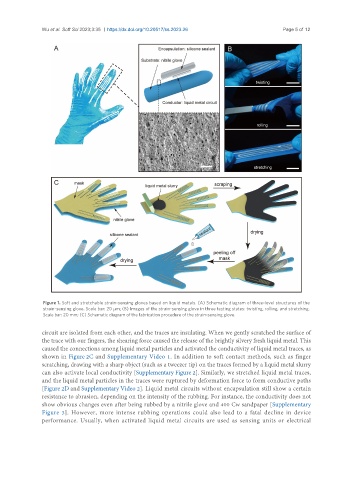
Wu et al. Soft Sci 2023;3:35  https://dx.doi.org/10.20517/ss.2023.26             Page 5 of 12


                Figure 1. Soft and stretchable strain-sensing gloves based on liquid metals. (A) Schematic diagram of three-level structures of the
                strain-sensing glove. Scale bar: 20 μm; (B) Images of the strain-sensing glove in three testing states: twisting, rolling, and stretching.
                Scale bar: 20 mm; (C) Schematic diagram of the fabrication procedure of the strain-sensing glove.

               circuit are isolated from each other, and the traces are insulating. When we gently scratched the surface of
               the trace with our fingers, the shearing force caused the release of the brightly silvery fresh liquid metal. This
               caused the connections among liquid metal particles and activated the conductivity of liquid metal traces, as
               shown in Figure 2C and Supplementary Video 1. In addition to soft contact methods, such as finger
               scratching, drawing with a sharp object (such as a tweezer tip) on the traces formed by a liquid metal slurry
               can also activate local conductivity [Supplementary Figure 2]. Similarly, we stretched liquid metal traces,
               and the liquid metal particles in the traces were ruptured by deformation force to form conductive paths
               [Figure 2D and Supplementary Video 2]. Liquid metal circuits without encapsulation still show a certain
               resistance to abrasion, depending on the intensity of the rubbing. For instance, the conductivity does not
               show obvious changes even after being rubbed by a nitrile glove and 400 Cw sandpaper [Supplementary
               Figure 3]. However, more intense rubbing operations could also lead to a fatal decline in device
               performance. Usually, when activated liquid metal circuits are used as sensing units or electrical

