


Page 18 - Read Online
P. 18
Page 6 of 9                                Ma et al. Soft Sci 2024;4:8  https://dx.doi.org/10.20517/ss.2023.41


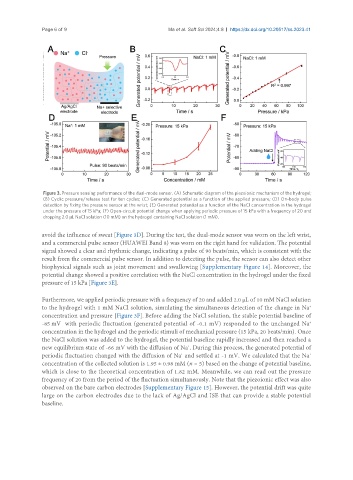
                Figure 3. Pressure sensing performance of the dual-mode sensor. (A) Schematic diagram of the piezoionic mechanism of the hydrogel;
                (B) Cyclic pressure/release test for ten cycles; (C) Generated potential as a function of the applied pressure; (D) On-body pulse
                detection by fixing the pressure sensor at the wrist; (E) Generated potential as a function of the NaCl concentration in the hydrogel
                under the pressure of 15 kPa; (F) Open-circuit potential change when applying periodic pressure of 15 kPa with a frequency of 20 and
                dropping 2.0 μL NaCl solution (10 mM) on the hydrogel containing NaCl solution (1 mM).


               avoid the influence of sweat [Figure 3D]. During the test, the dual-mode sensor was worn on the left wrist,
               and a commercial pulse sensor (HUAWEI Band 8) was worn on the right hand for validation. The potential
               signal showed a clear and rhythmic change, indicating a pulse of 90 beats/min, which is consistent with the
               result from the commercial pulse sensor. In addition to detecting the pulse, the sensor can also detect other
               biophysical signals such as joint movement and swallowing [Supplementary Figure 14]. Moreover, the
               potential change showed a positive correlation with the NaCl concentration in the hydrogel under the fixed
               pressure of 15 kPa [Figure 3E].

               Furthermore, we applied periodic pressure with a frequency of 20 and added 2.0 μL of 10 mM NaCl solution
               to the hydrogel with 1 mM NaCl solution, simulating the simultaneous detection of the change in Na
                                                                                                         +
               concentration and pressure [Figure 3F]. Before adding the NaCl solution, the stable potential baseline of
               -85 mV  with periodic fluctuation (generated potential of -0.1 mV) responded to the unchanged Na
                                                                                                         +
               concentration in the hydrogel and the periodic stimuli of mechanical pressure (15 kPa, 20 beats/min). Once
               the NaCl solution was added to the hydrogel, the potential baseline rapidly increased and then reached a
               new equilibrium state of -66 mV with the diffusion of Na . During this process, the generated potential of
                                                                +
                                                              +
                                                                                                         +
               periodic fluctuation changed with the diffusion of Na  and settled at -1 mV. We calculated that the Na
               concentration of the collected solution is 1.95 ± 0.98 mM (n = 5) based on the change of potential baseline,
               which is close to the theoretical concentration of 1.82 mM. Meanwhile, we can read out the pressure
               frequency of 20 from the period of the fluctuation simultaneously. Note that the piezoionic effect was also
               observed on the bare carbon electrodes [Supplementary Figure 15]. However, the potential drift was quite
               large on the carbon electrodes due to the lack of Ag/AgCl and ISE that can provide a stable potential
               baseline.

