


Page 17 - Read Online
P. 17
Ma et al. Soft Sci 2024;4:8  https://dx.doi.org/10.20517/ss.2023.41              Page 5 of 9


                                    +
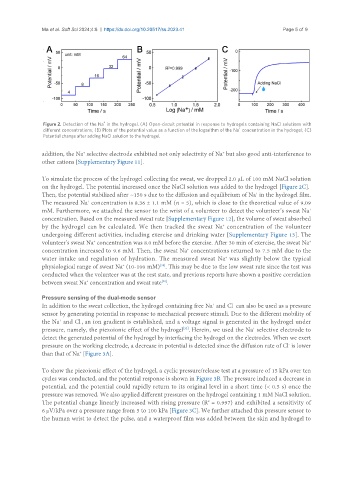
                Figure 2. Detection of the Na  in the hydrogel. (A) Open-circuit potential in response to hydrogels containing NaCl solutions with
                                                                                  +
                different concentrations; (B) Plots of the potential value as a function of the logarithm of the Na  concentration in the hydrogel; (C)
                Potential change after adding NaCl solution to the hydrogel.
               addition, the Na  selective electrode exhibited not only selectivity of Na  but also good anti-interference to
                             +
                                                                            +
               other cations [Supplementary Figure 11].
               To simulate the process of the hydrogel collecting the sweat, we dropped 2.0 μL of 100 mM NaCl solution
               on the hydrogel. The potential increased once the NaCl solution was added to the hydrogel [Figure 2C].
               Then, the potential stabilized after ~150 s due to the diffusion and equilibrium of Na  in the hydrogel film.
                                                                                       +
               The measured Na  concentration is 8.36 ± 1.1 mM (n = 5), which is close to the theoretical value of 9.09
                               +
                                                                                                         +
               mM. Furthermore, we attached the sensor to the wrist of a volunteer to detect the volunteer’s sweat Na
               concentration. Based on the measured sweat rate [Supplementary Figure 12], the volume of sweat absorbed
               by the hydrogel can be calculated. We then tracked the sweat Na  concentration of the volunteer
                                                                            +
               undergoing different activities, including exercise and drinking water [Supplementary Figure 13]. The
                                                                                                         +
               volunteer’s sweat Na  concentration was 8.0 mM before the exercise. After 30 min of exercise, the sweat Na
                                 +
               concentration increased to 9.6 mM. Then, the sweat Na  concentrations returned to 7.5 mM due to the
                                                                +
               water intake and regulation of hydration. The measured sweat Na  was slightly below the typical
                                                                             +
               physiological range of sweat Na  (10-100 mM) . This may be due to the low sweat rate since the test was
                                          +
                                                       [39]
               conducted when the volunteer was at the rest state, and previous reports have shown a positive correlation
               between sweat Na  concentration and sweat rate .
                                                       [40]
                              +
               Pressure sensing of the dual-mode sensor
                                                                         +
                                                                                -
               In addition to the sweat collection, the hydrogel containing free Na  and Cl  can also be used as a pressure
               sensor by generating potential in response to mechanical pressure stimuli. Due to the different mobility of
                     +
               the Na  and Cl , an ion gradient is established, and a voltage signal is generated in the hydrogel under
                            -
               pressure, namely, the piezoionic effect of the hydrogel . Herein, we used the Na  selective electrode to
                                                               [32]
                                                                                      +
               detect the generated potential of the hydrogel by interfacing the hydrogel on the electrodes. When we exert
               pressure on the working electrode, a decrease in potential is detected since the diffusion rate of Cl  is lower
                                                                                                  -
                            +
               than that of Na  [Figure 3A].
               To show the piezoionic effect of the hydrogel, a cyclic pressure/release test at a pressure of 15 kPa over ten
               cycles was conducted, and the potential response is shown in Figure 3B. The pressure induced a decrease in
               potential, and the potential could rapidly return to its original level in a short time (< 0.5 s) once the
               pressure was removed. We also applied different pressures on the hydrogel containing 1 mM NaCl solution.
               The potential change linearly increased with rising pressure (R  = 0.997) and exhibited a sensitivity of
                                                                       2
               6 μV/kPa over a pressure range from 5 to 100 kPa [Figure 3C]. We further attached this pressure sensor to
               the human wrist to detect the pulse, and a waterproof film was added between the skin and hydrogel to

