


Page 16 - Read Online
P. 16
Page 4 of 9                                Ma et al. Soft Sci 2024;4:8  https://dx.doi.org/10.20517/ss.2023.41


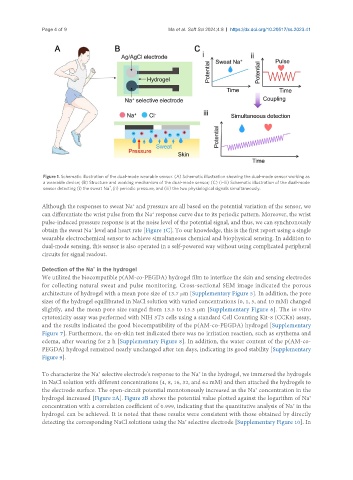
                Figure 1. Schematic illustration of the dual-mode wearable sensor. (A) Schematic illustration showing the dual-mode sensor working as
                a wearable device; (B) Structure and working mechanism of the dual-mode sensor; (C) (i-iii) Schematic illustration of the dual-mode
                                      +
                sensor detecting (i) the sweat Na , (ii) periodic pressure, and (iii) the two physiological signals simultaneously.

                                              +
               Although the responses to sweat Na  and pressure are all based on the potential variation of the sensor, we
               can differentiate the wrist pulse from the Na  response curve due to its periodic pattern. Moreover, the wrist
                                                    +
               pulse-induced pressure response is at the noise level of the potential signal, and thus, we can synchronously
               obtain the sweat Na  level and heart rate [Figure 1C]. To our knowledge, this is the first report using a single
                                +
               wearable electrochemical sensor to achieve simultaneous chemical and biophysical sensing. In addition to
               dual-mode sensing, this sensor is also operated in a self-powered way without using complicated peripheral
               circuits for signal readout.

                                +
               Detection of the Na  in the hydrogel
               We utilized the biocompatible p(AM-co-PEGDA) hydrogel film to interface the skin and sensing electrodes
               for collecting natural sweat and pulse monitoring. Cross-sectional SEM image indicated the porous
               architecture of hydrogel with a mean pore size of 13.7 μm [Supplementary Figure 5]. In addition, the pore
               sizes of the hydrogel equilibrated in NaCl solution with varied concentrations (0, 1, 5, and 10 mM) changed
               slightly, and the mean pore size ranged from 13.5 to 15.3 μm [Supplementary Figure 6]. The in vitro
               cytotoxicity assay was performed with NIH 3T3 cells using a standard Cell Counting Kit-8 (CCK8) assay,
               and the results indicated the good biocompatibility of the p(AM-co-PEGDA) hydrogel [Supplementary
               Figure 7]. Furthermore, the on-skin test indicated there was no irritation reaction, such as erythema and
               edema, after wearing for 2 h [Supplementary Figure 8]. In addition, the water content of the p(AM-co-
               PEGDA) hydrogel remained nearly unchanged after ten days, indicating its good stability [Supplementary
               Figure 9].


               To characterize the Na  selective electrode’s response to the Na  in the hydrogel, we immersed the hydrogels
                                  +
                                                                    +
               in NaCl solution with different concentrations (4, 8, 16, 32, and 64 mM) and then attached the hydrogels to
                                                                                       +
               the electrode surface. The open-circuit potential monotonously increased as the Na  concentration in the
               hydrogel increased [Figure 2A]. Figure 2B shows the potential value plotted against the logarithm of Na
                                                                                                         +
                                                                                                    +
               concentration with a correlation coefficient of 0.999, indicating that the quantitative analysis of Na  in the
               hydrogel can be achieved. It is noted that these results were consistent with those obtained by directly
                                                               +
               detecting the corresponding NaCl solutions using the Na  selective electrode [Supplementary Figure 10]. In

