


Page 81 - Read Online
P. 81
Page 18 of 25                             Lin et al. Soft Sci 2023;3:14  https://dx.doi.org/10.20517/ss.2023.05

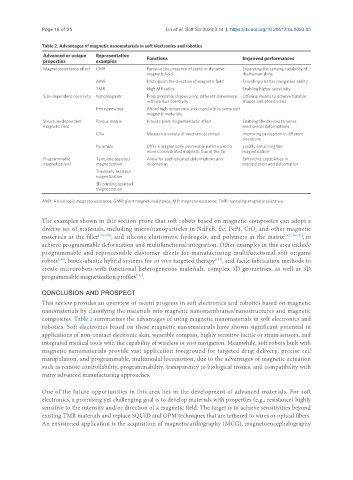
               Table 2. Advantages of magnetic nanomaterials in soft electronics and robotics
                Advanced or unique   Representative   Functions                    Improved performances
                properties       examples
                Magnetoresistance effect  GMR     Perceive the presence of static or dynamic   Expanding the sensing capability of
                                                  magnetic field                   the human skins
                                 AMR              Distinguish the direction of magnetic field  Providing a better navigation ability
                                 TMR              High MR ratios                   Enabling higher sensitivity
                Size-dependent coercivity  Nanomagnets  Programmable shapes using different dimensions  Offering means to achieve tunable
                                                  with various coercivity          shapes and sensitivities
                                 Iron nanowires   Afford high remanence and coercivity to some soft
                                                  magnetic materials
                Structure-dependent   Porous matrix  Provide giant magnetoelastic effect  Enabling the devices to sense
                magnetic field                                                     mechanical deformations
                                 Cilia            Measure a variety of mechanical stimuli  Improving perception in different
                                                                                   directions
                                 Pyramids         Offer a magnetically permeable path to yield a   Locally enhancing the
                                                  more concentrated magnetic flux at the tip   magnetization
                Programmable     Template assisted   Allow for sophisticated deformations and   Enhancing capabilities in
                magnetization1   magnetization    locomotion                       manipulation and deformation
                                 Thermally assisted
                                 magnetization
                                 3D printing assisted
                                 magnetization

               AMR: Anisotropic magnetoresistance; GMR: giant magnetoresistance; MR: magnetoresistance; TMR: tunneling magnetoresistance.


               The examples shown in this section prove that soft robots based on magnetic composites can adopt a
               diverse set of materials, including micro/nanoparticles in NdFeB, Fe, FePt, CrO  and other magnetic
                                                                                       2
               materials as the filler [172-175] , and silicone elastomers, hydrogels, and polymers as the matrix [167,176-179] , to
               achieve programmable deformation and multifunctional integration. Other examples in this area include
               programmable and reprocessable elastomer sheets for manufacturing multifunctional soft origami
               robots , biotic-abiotic hybrid systems for in vivo targeted therapy , and facile fabrication methods to
                     [180]
                                                                         [181]
               create microrobots with functional heterogeneous materials, complex 3D geometries, as well as 3D
               programmable magnetization profiles .
                                               [182]
               CONCLUSION AND PROSPECT
               This review provides an overview of recent progress in soft electronics and robotics based on magnetic
               nanomaterials by classifying the materials into magnetic nanomembranes/nanostructures and magnetic
               composites. Table 2 summarizes the advantages of using magnetic nanomaterials in soft electronics and
               robotics. Soft electronics based on these magnetic nanomaterials have shown significant potential in
               applications of non-contact electronic skin, wearable compass, highly sensitive tactile or strain sensors, and
               integrated medical tools with the capability of wireless in vivo navigation. Meanwhile, soft robots built with
               magnetic nanomaterials provide vast application foreground for targeted drug delivery, precise cell
               manipulation, and programmable, multimodal locomotion, due to the advantages of magnetic actuation
               such as remote controllability, programmability, transparency to biological tissues, and compatibility with
               many advanced manufacturing approaches.


               One of the future opportunities in this area lies in the development of advanced materials. For soft
               electronics, a promising yet challenging goal is to develop materials with properties (e.g., resistance) highly
               sensitive to the intensity and/or direction of a magnetic field. The target is to achieve sensitivities beyond
               existing TMR materials and replace SQUID and OPM techniques that are tethered to wires or optical fibers.
               An envisioned application is the acquisition of magnetocardiography (MCG), magnetoencephalography

