


Page 9 - Read Online
P. 9
Larshans et al. Plast Aesthet Res. 2025;12:7  https://dx.doi.org/10.20517/2347-9264.2024.154  Page 3 of 13

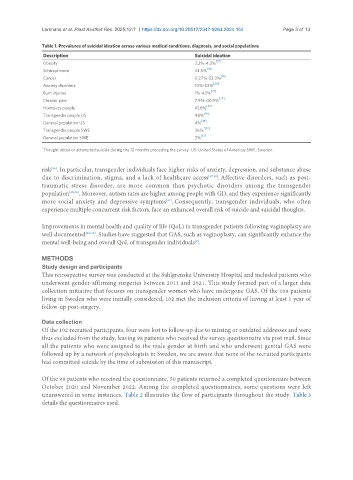
               Table 1. Prevalence of suicidal ideation across various medical conditions, diagnosis, and social populations
                Description                                        Suicidal ideation
                Obesity                                            3.2%-4.3% [17]
                                                                       [18]
                Schizophrenia                                      34.5%
                                                                           [19]
                Cancer                                             0.27%-53.3%
                                                                         [20]
                Anxiety disorders                                  10%-53%
                                                                        [21]
                Burn injuries                                      1%-43%
                Chronic pain                                       7.9%-40.9% [22]
                                                                       [23]
                Homeless people                                    41.6%
                Transgender people US                              48% [16]
                                                                     [16]
                General population US                              4%
                Transgender people SWE                             36% *[12]
                                                                     [12]
                General population SWE                             3%
               *
                Thought about or attempted suicide during the 12 months preceding the survey. US: United States of America; SWE: Sweden.

               risk . In particular, transgender individuals face higher risks of anxiety, depression, and substance abuse
                  [26]
               due to discrimination, stigma, and a lack of healthcare access [27,28] . Affective disorders, such as post-
               traumatic  stress  disorder,  are  more  common  than  psychotic  disorders  among  the  transgender
               population [29,30] . Moreover, autism rates are higher among people with GD, and they experience significantly
               more social anxiety and depressive symptoms . Consequently, transgender individuals, who often
                                                         [31]
               experience multiple concurrent risk factors, face an enhanced overall risk of suicide and suicidal thoughts.

               Improvements in mental health and quality of life (QoL) in transgender patients following vaginoplasty are
               well-documented [32-36] . Studies have suggested that GAS, such as vaginoplasty, can significantly enhance the
               mental well-being and overall QoL of transgender individuals .
                                                                   [9]

               METHODS
               Study design and participants
               This retrospective survey was conducted at the Sahlgrenska University Hospital and included patients who
               underwent gender-affirming surgeries between 2011 and 2021. This study formed part of a larger data
               collection initiative that focuses on transgender women who have undergone GAS. Of the 108 patients
               living in Sweden who were initially considered, 102 met the inclusion criteria of having at least 1 year of
               follow-up post-surgery.

               Data collection
               Of the 102 recruited participants, four were lost to follow-up due to missing or outdated addresses and were
               thus excluded from the study, leaving 98 patients who received the survey questionnaire via post mail. Since
               all the patients who were assigned to the male gender at birth and who underwent genital GAS were
               followed up by a network of psychologists in Sweden, we are aware that none of the recruited participants
               had committed suicide by the time of submission of this manuscript.


               Of the 98 patients who received the questionnaire, 50 patients returned a completed questionnaire between
               October 2020 and November 2022. Among the completed questionnaires, some questions were left
               unanswered in some instances. Table 2 illustrates the flow of participants throughout the study. Table 3
               details the questionnaires used.

