


Page 11 - Read Online
P. 11
Larshans et al. Plast Aesthet Res. 2025;12:7  https://dx.doi.org/10.20517/2347-9264.2024.154  Page 5 of 13

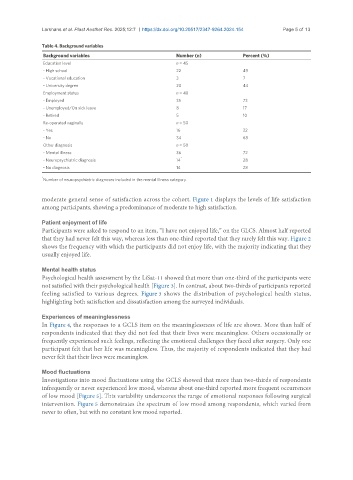
               Table 4. Background variables
                Background variables                        Number (n)             Percent (%)
                Education level                             n = 45
                - High school                               22                     49
                - Vocational education                      3                      7
                - University degree                         20                     44
                Employment status                           n = 48
                - Employed                                  35                     73
                - Unemployed/On sick leave                  8                      17
                - Retired                                   5                      10
                Re-operated vaginally                       n = 50
                - Yes                                       16                     32
                - No                                        34                     68
                Other diagnosis                             n = 50
                - Mental illness                            36                     72
                                                              *
                - Neuropsychiatric diagnosis                14                     28
                - No diagnosis                              14                     28
               *
                Number of neuropsychiatric diagnoses included in the mental illness category.

               moderate general sense of satisfaction across the cohort. Figure 1 displays the levels of life satisfaction
               among participants, showing a predominance of moderate to high satisfaction.

               Patient enjoyment of life
               Participants were asked to respond to an item, “I have not enjoyed life,” on the GLCS. Almost half reported
               that they had never felt this way, whereas less than one-third reported that they rarely felt this way. Figure 2
               shows the frequency with which the participants did not enjoy life, with the majority indicating that they
               usually enjoyed life.

               Mental health status
               Psychological health assessment by the LiSat-11 showed that more than one-third of the participants were
               not satisfied with their psychological health [Figure 3]. In contrast, about two-thirds of participants reported
               feeling satisfied to various degrees. Figure 3 shows the distribution of psychological health status,
               highlighting both satisfaction and dissatisfaction among the surveyed individuals.

               Experiences of meaninglessness
               In Figure 4, the responses to a GCLS item on the meaninglessness of life are shown. More than half of
               respondents indicated that they did not feel that their lives were meaningless. Others occasionally or
               frequently experienced such feelings, reflecting the emotional challenges they faced after surgery. Only one
               participant felt that her life was meaningless. Thus, the majority of respondents indicated that they had
               never felt that their lives were meaningless.


               Mood fluctuations
               Investigations into mood fluctuations using the GCLS showed that more than two-thirds of respondents
               infrequently or never experienced low mood, whereas about one-third reported more frequent occurrences
               of low mood [Figure 5]. This variability underscores the range of emotional responses following surgical
               intervention. Figure 5 demonstrates the spectrum of low mood among respondents, which varied from
               never to often, but with no constant low mood reported.

