


Page 10 - Read Online
P. 10
Page 4 of 13           Larshans et al. Plast Aesthet Res. 2025;12:7  https://dx.doi.org/10.20517/2347-9264.2024.154

               Table 2. Details of participant engagement and response rates
                Description                                                      Number
                Considered participants                                          108
                Met inclusion criteria                                           102
                Lost to follow-up                                                4
                Questionnaires distributed                                       98
                Respondents                                                      50


               Table 3. Overview of the questionnaires used
                Code      Description
                Q1        LiSat-11 - Life Satisfaction Questionnaire
                Q2        GCLS - Gender Congruence and Life Satisfaction Scale
                Q3        Demographic Health Survey


               Participants were surveyed using the Life Satisfaction Questionnaire (LiSat-11) [37,38] , Gender Congruence and
               Life Satisfaction Scale (GCLS) , and a general Demographic Health Survey to obtain basic demographic
                                         [39]
               information and health data.


               Statistical analysis
               This cross-sectional analysis focused on a selection of questions from the GCLS, LiSat-11, and Demographic
               Health Survey to provide targeted insights into thoughts of self-harm, suicidal ideation, and QoL in
               transgender women following GAS. Descriptive statistics were performed using SPSS software (version 29;
               IBM Inc., Armonk, NY, USA) to analyze the data collected from the questionnaires.


               Ethics and consent
               Ethical approval was obtained from the Swedish Ethical Review Authority, application number 2020-03062.
               To protect patient anonymity, individuals were assigned codes prior to the questionnaire distribution.
               Written informed consent was obtained from all participants to ensure adherence to the ethical standards
               for research involving human subjects.


               RESULTS
               Response rate and participant characteristics
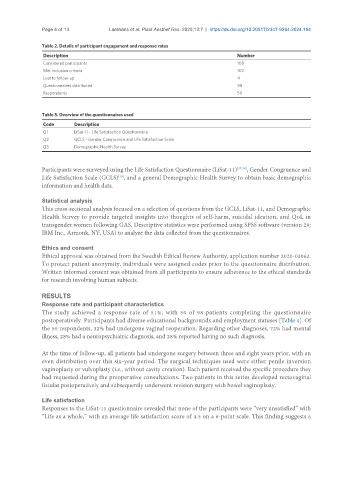
               The study achieved a response rate of 51%, with 50 of 98 patients completing the questionnaire
               postoperatively. Participants had diverse educational backgrounds and employment statuses [Table 4]. Of
               the 50 respondents, 32% had undergone vaginal reoperation. Regarding other diagnoses, 72% had mental
               illness, 28% had a neuropsychiatric diagnosis, and 28% reported having no such diagnosis.


               At the time of follow-up, all patients had undergone surgery between three and eight years prior, with an
               even distribution over this six-year period. The surgical techniques used were either penile inversion
               vaginoplasty or vulvoplasty (i.e., without cavity creation). Each patient received the specific procedure they
               had requested during the preoperative consultations. Two patients in this series developed rectovaginal
               fistulas postoperatively and subsequently underwent revision surgery with bowel vaginoplasty.


               Life satisfaction
               Responses to the LiSat-11 questionnaire revealed that none of the participants were “very unsatisfied” with
               “Life as a whole,” with an average life satisfaction score of 4.5 on a 6-point scale. This finding suggests a

