


Page 118 - Read Online
P. 118
Kant et al. Plast Aesthet Res. 2026;13:4                                         Page 11 of 20


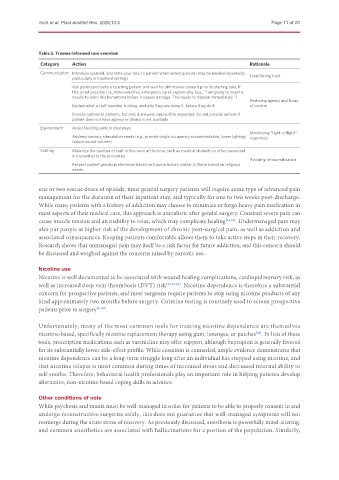
               Table 5. Trauma-informed care overview
               Category   Action                                                         Rationale

               Communication Introduce yourself, and state your role, to patient when entering room (may be needed repeatedly,  Establishing trust
                          particularly in inpatient setting)
                          Ask permission before touching patient and wait for affirmative consent prior to starting care. If
                          this is not possible (i.e., time-sensitive, emergency care) explain why (e.g., “I am going to insert a
                          needle to drain this hematoma before it causes damage. This needs to happen immediately.”)
                                                                                         Restoring agency and locus
                          Explain what a staff member is doing, and why they are doing it, before they do it  of control
                          Provide options to patients, but only if answers can/will be respected. Do not provide options if
                          patient does not have agency or choice is not available
               Environment  Avoid blocking exits or doorways
                                                                                         Minimizing “fight or flight”
                          Address sensory stimulation needs (e.g., provide single occupancy accommodation, lower lighting,  responses
                          reduce sound volume)
               Staffing   Minimize the number of staff in the room at the time, such as medical students or other personnel
                          not essential to the procedure
                                                                                         Avoiding retraumatization
                          Respect patient gender preferences based on trauma history similar to those based on religious
                          needs

               one or two rescue doses of opioids, most genital surgery patients will require some type of advanced pain
               management for the duration of their inpatient stay, and typically for one to two weeks post-discharge.
               While many patients with a history of addiction may choose to minimize or forgo heavy pain medication in
               most aspects of their medical care, this approach is unrealistic after genital surgery. Constant severe pain can
               cause muscle tension and an inability to relax, which may complicate healing [84-86] . Undermanaged pain may
               also put people at higher risk of the development of chronic post-surgical pain, as well as addiction and
               associated consequences. Keeping patients comfortable allows them to take active steps in their recovery.
               Research shows that unmanaged pain may itself be a risk factor for future addiction, and this concern should
               be discussed and weighed against the concerns raised by narcotic use.


               Nicotine use
               Nicotine is well documented to be associated with wound healing complications, cardiopulmonary risk, as
               well as increased deep vein thrombosis (DVT) risk [33,87,88] . Nicotine dependence is therefore a substantial
               concern for prospective patients, and most surgeons require patients to stop using nicotine products of any
               kind approximately two months before surgery. Cotinine testing is routinely used to screen prospective
               patients prior to surgery [87,88] .

               Unfortunately, many of the most common tools for treating nicotine dependence are themselves
               nicotine-based, specifically nicotine replacement therapy using gum, lozenges, or patches . In lieu of these
                                                                                           [88]
              tools, prescription medications such as varenicline may offer support, although bupropion is generally favored
               for its substantially lower side-effect profile. While cessation is counseled, ample evidence demonstrates that
               nicotine dependence can be a long-term struggle long after an individual has stopped using nicotine, and
               that nicotine relapse is most common during times of increased stress and decreased internal ability to
               self-soothe. Therefore, behavioral health professionals play an important role in helping patients develop
               alternative, non-nicotine-based coping skills in advance.

               Other conditions of note
               While psychosis and mania must be well-managed in order for patients to be able to properly consent to and
               undergo reconstructive surgeries safely, this does not guarantee that well-managed symptoms will not
               reemerge during the acute stress of recovery. As previously discussed, anesthesia is powerfully mind-altering,
               and common anesthetics are associated with hallucinations for a portion of the population. Similarly,

