


Page 122 - Read Online
P. 122
Kant et al. Plast Aesthet Res. 2026;13:4                                         Page 15 of 20


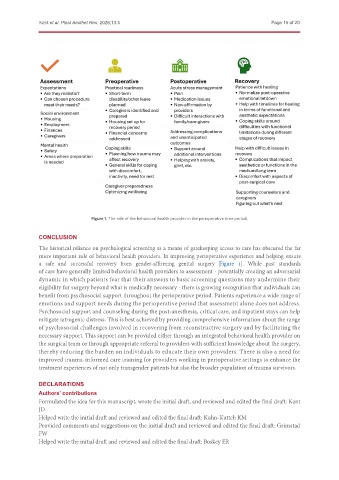
                                 Figure 1. The role of the behavioral health provider in the perioperative time period.


               CONCLUSION
               The historical reliance on psychological screening as a means of gatekeeping access to care has obscured the far
               more important role of behavioral health providers. In improving perioperative experience and helping ensure
               a  safe  and  successful  recovery  from  gender-affirming  genital  surgery  [ Figure  1].  While  past  standards
               of care have generally limited behavioral health providers to assessment - potentially creating an adversarial
               dynamic in which patients fear that their answers to basic screening questions may undermine their
               eligibility for surgery beyond what is medically necessary - there is growing recognition that individuals can
               benefit from psychosocial support throughout the perioperative period. Patients experience a wide range of
               emotions and support needs during the perioperative period that assessment alone does not address.
               Psychosocial support and counseling during the post-anesthesia, critical care, and inpatient stays can help
               mitigate iatrogenic distress. This is best achieved by providing comprehensive information about the range
               of psychosocial challenges involved in recovering from reconstructive surgery and by facilitating the
               necessary support. This support can be provided either through an integrated behavioral health provider on
               the surgical team or through appropriate referral to providers with sufficient knowledge about the surgery,
               thereby reducing the burden on individuals to educate their own providers. There is also a need for
               improved trauma-informed care training for providers working in perioperative settings to enhance the
               treatment experiences of not only transgender patients but also the broader population of trauma survivors.

               DECLARATIONS

               Authors’ contributions
               Formulated the idea for this manuscript, wrote the initial draft, and reviewed and edited the final draft: Kant
               JD
               Helped write the initial draft and reviewed and edited the final draft: Kuhn-Kutteh KM
               Provided comments and suggestions on the initial draft and reviewed and edited the final draft: Grimstad
               FW
               Helped write the initial draft and reviewed and edited the final draft: Boskey ER

