


Page 115 - Read Online
P. 115
Page 8 of 20                                                   Kant et al. Plast Aesthet Res. 2026;13:4


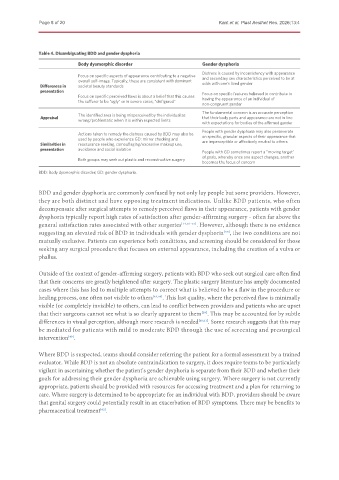
               Table 4. Disambiguating BDD and gender dysphoria
                             Body dysmorphic disorder                   Gender dysphoria

                                                                        Distress is caused by inconsistency with appearance
                             Focus on specific aspects of appearance contributing to a negative
                             overall self-image. Typically, these are consistent with dominant  and secondary sex characteristics perceived to be at
               Differences in  societal beauty standards                odds with one’s lived gender
               presentation
                             Focus on specific perceived flaws is about a belief that this causes  Focus on specific features believed to contribute to
                             the sufferer to be “ugly” or in severe cases, “disfigured”  having the appearance of an individual of
                                                                        non-congruent gender
                                                                        The fundamental concern is an accurate perception
                             The identified area is being misperceived by the individual as
               Appraisal                                                that their body parts and appearance are not in line
                             wrong/problematic when it is within expected limits
                                                                        with expectations for bodies of the affirmed gender
                                                                        People with gender dysphoria may also perseverate
                             Actions taken to remedy the distress caused by BDD may also be
                             used by people who experience GD: mirror checking and  on specific, granular aspects of their appearance that
               Similarities in  reassurance seeking, camouflaging/excessive makeup use,  are imperceptible or affectively neutral to others
               presentation  avoidance and social isolation
                                                                        People with GD sometimes report a “moving target”
                                                                        of goals, whereby once one aspect changes, another
                             Both groups may seek out plastic and reconstructive surgery
                                                                        becomes the focus of concern
               BDD: Body dysmorphic disorder; GD: gender dysphoria.

               BDD and gender dysphoria are commonly confused by not only lay people but some providers. However,
               they are both distinct and have opposing treatment indications. Unlike BDD patients, who often
               decompensate after surgical attempts to remedy perceived flaws in their appearance, patients with gender
               dysphoria typically report high rates of satisfaction after gender-affirming surgery - often far above the
               general satisfaction rates associated with other surgeries [14,51-57] . However, although there is no evidence
               suggesting an elevated risk of BDD in individuals with gender dysphoria , the two conditions are not
                                                                                [58]
               mutually exclusive. Patients can experience both conditions, and screening should be considered for those
               seeking any surgical procedure that focuses on external appearance, including the creation of a vulva or
               phallus.


               Outside of the context of gender-affirming surgery, patients with BDD who seek out surgical care often find
               that their concerns are greatly heightened after surgery. The plastic surgery literature has amply documented
               cases where this has led to multiple attempts to correct what is believed to be a flaw in the procedure or
               healing process, one often not visible to others [49,59] . This last quality, where the perceived flaw is minimally
               visible (or completely invisible) to others, can lead to conflict between providers and patients who are upset
               that their surgeons cannot see what is so clearly apparent to them . This may be accounted for by subtle
                                                                        [59]
               differences in visual perception, although more research is needed [60,61] . Some research suggests that this may
               be mediated for patients with mild to moderate BDD through the use of screening and presurgical
               intervention .
                         [49]

               Where BDD is suspected, teams should consider referring the patient for a formal assessment by a trained
               evaluator. While BDD is not an absolute contraindication to surgery, it does require teams to be particularly
               vigilant in ascertaining whether the patient’s gender dysphoria is separate from their BDD and whether their
               goals for addressing their gender dysphoria are achievable using surgery. Where surgery is not currently
               appropriate, patients should be provided with resources for accessing treatment and a plan for returning to
               care. Where surgery is determined to be appropriate for an individual with BDD, providers should be aware
               that genital surgery could potentially result in an exacerbation of BDD symptoms. There may be benefits to
               pharmaceutical treatment .
                                    [62]

