


Page 41 - Read Online
P. 41
Rodriguez. Plast Aesthet Res 2023;10:67  https://dx.doi.org/10.20517/2347-9264.2023.73  Page 15 of 18


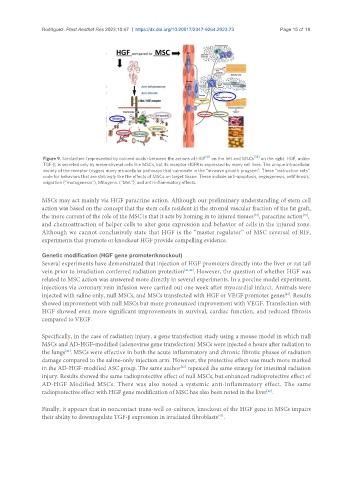
                Figure 9. Similarities (represented by colored ovals) between the actions of HGF [31]  on the left and MSCs [38]  on the right. HGF, unlike
                TGF-β, is secreted only by mesenchymal cells like MSCs, but its receptor HGFR is expressed by many cell lines. The unique intracellular
                moiety of the receptor triggers many intracellular pathways that culminate in the “invasive growth program”. These “instruction sets”
                code for behaviors that are strikingly like the effects of MSCs on target tissue. These include anti-apoptosis, angiogenesis, antifibrosis,
                migration (“motogenesis”), Mitogenic (“Met”), and anti-inflammatory effects.

               MSCs may act mainly via HGF paracrine action. Although our preliminary understanding of stem cell
               action was based on the concept that the stem cells resident in the stromal vascular fraction of the fat graft,
                                                                                      [39]
                                                                                                       [40]
               the more current of the role of the MSC is that it acts by homing in to injured tissues , paracrine action ,
               and chemoattraction of helper cells to alter gene expression and behavior of cells in the injured zone.
               Although we cannot conclusively state that HGF is the “master regulator” of MSC reversal of RIF,
               experiments that promote or knockout HGF provide compelling evidence.

               Genetic modification (HGF gene promoter/knockout)
               Several experiments have demonstrated that injection of HGF promoters directly into the liver or rat tail
               vein prior to irradiation conferred radiation protection [41,42] . However, the question of whether HGF was
               related to MSC action was answered more directly in several experiments. In a porcine model experiment,
               injections via coronary vein infusion were carried out one week after myocardial infarct. Animals were
                                                                                                 [43]
               injected with saline only, null MSCs, and MSCs transfected with HGF or VEGF promoter genes . Results
               showed improvement with null MSCs but more pronounced improvement with VEGF. Transfection with
               HGF showed even more significant improvements in survival, cardiac function, and reduced fibrosis
               compared to VEGF.


               Specifically, in the case of radiation injury, a gene transfection study using a mouse model in which null
               MSCs and AD-HGF-modified (adenovirus gene transfection) MSCs were injected 6 hours after radiation to
               the lungs . MSCs were effective in both the acute inflammatory and chronic fibrotic phases of radiation
                       [44]
               damage compared to the saline-only injection arm. However, the protective effect was much more marked
               in the AD-HGF-modified ASC group. The same author  repeated the same strategy for intestinal radiation
                                                              [45]
               injury. Results showed the same radioprotective effect of null MSCs, but enhanced radioprotective effect of
               AD-HGF Modified MSCs. There was also noted a systemic anti-inflammatory effect. The same
               radioprotective effect with HGF gene modification of MSC has also been noted in the liver .
                                                                                           [46]
               Finally, it appears that in noncontact trans-well co-cultures, knockout of the HGF gene in MSCs impairs
               their ability to downregulate TGF-β expression in irradiated fibroblasts .
                                                                          [47]

