


Page 69 - Read Online
P. 69
Page 4 of 8              Li et al. Metab Target Organ Damage. 2025;5:19  https://dx.doi.org/10.20517/mtod.2025.05

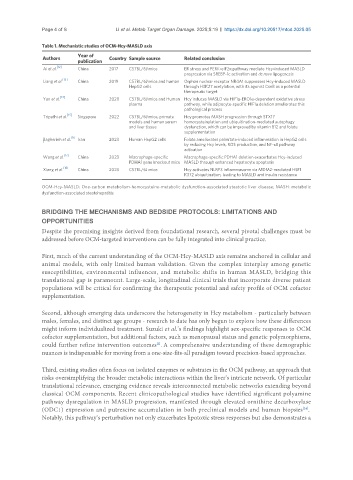
               Table 1. Mechanistic studies of OCM-Hcy-MASLD axis
                           Year of
               Authors                Country Sample source    Related conclusion
                           publication
                    [12]
                Ai et al.  China      2017   C57BL/6J mice     ER stress and PERK-eIF2α pathway mediate Hcy-induced MASLD
                                                               progression via SREBP-1c activation and de novo lipogenesis
                      [13]
                Liang et al.  China   2019   C57BL/6J mice and human  Orphan nuclear receptor NR4A1 suppresses Hcy-induced MASLD
                                             HepG2 cells       through H3K27 acetylation, with its agonist CsnB as a potential
                                                               therapeutic target
                     [14]
                Yan et al.  China     2020   C57BL/6J mice and Human  Hcy induces MASLD via HIF1α-ERO1α-dependent oxidative stress
                                             plasma            pathway, while adipocyte-specific HIF1α deletion ameliorates this
                                                               pathological process
                        [15]
                Tripathi et al.  Singapore  2022  C57BL/6J mice, primate   Hcy promotes MASH progression through STX17
                                             models and human serum   homocysteinylation and ubiquitination-mediated autophagy
                                             and liver tissue  dysfunction, which can be improved by vitamin B12 and folate
                                                               supplementation
                         [16
                Bagherieh et al.  Iran  2023  Human HepG2 cells  Folate ameliorates palmitate-induced inflammation in HepG2 cells
                ]
                                                               by reducing Hcy levels, ROS production, and NF-κB pathway
                                                               activation
                Wang et al. [17]  China  2023  Macrophage-specific   Macrophage-specific PDHA1 deletion exacerbates Hcy-induced
                                             PDHA1 gene knockout mice MASLD through enhanced hepatocyte apoptosis
                      [18]
                Xiang et al.  China   2023   C57BL/6J mice     Hcy activates NLRP3 inflammasome via MDM2-mediated HSF1
                                                               K372 ubiquitination, leading to MASLD and insulin resistance
               OCM-Hcy-MASLD: One-carbon metabolism-homocysteine-metabolic dysfunction-associated steatotic liver disease; MASH: metabolic
               dysfunction-associated steatohepatitis.

               BRIDGING THE MECHANISMS AND BEDSIDE PROTOCOLS: LIMITATIONS AND
               OPPORTUNITIES
               Despite the promising insights derived from foundational research, several pivotal challenges must be
               addressed before OCM-targeted interventions can be fully integrated into clinical practice.

               First, much of the current understanding of the OCM-Hcy-MASLD axis remains anchored in cellular and
               animal models, with only limited human validation. Given the complex interplay among genetic
               susceptibilities, environmental influences, and metabolic shifts in human MASLD, bridging this
               translational gap is paramount. Large-scale, longitudinal clinical trials that incorporate diverse patient
               populations will be critical for confirming the therapeutic potential and safety profile of OCM cofactor
               supplementation.

               Second, although emerging data underscore the heterogeneity in Hcy metabolism - particularly between
               males, females, and distinct age groups - research to date has only begun to explore how these differences
               might inform individualized treatment. Suzuki et al.’s findings highlight sex-specific responses to OCM
               cofactor supplementation, but additional factors, such as menopausal status and genetic polymorphisms,
                                                      [2]
               could further refine intervention outcomes . A comprehensive understanding of these demographic
               nuances is indispensable for moving from a one-size-fits-all paradigm toward precision-based approaches.

               Third, existing studies often focus on isolated enzymes or substrates in the OCM pathway, an approach that
               risks oversimplifying the broader metabolic interactions within the liver’s intricate network. Of particular
               translational relevance, emerging evidence reveals interconnected metabolic networks extending beyond
               classical OCM components. Recent clinicopathological studies have identified significant polyamine
               pathway dysregulation in MASLD progression, manifested through elevated ornithine decarboxylase
                                                                                                       [24]
               (ODC1) expression and putrescine accumulation in both preclinical models and human biopsies .
               Notably, this pathway’s perturbation not only exacerbates lipotoxic stress responses but also demonstrates a

