


Page 32 - Read Online
P. 32
Page 12 of 18  Llamoza-Torres et al. Metab Target Organ Damage 2024;4:40  https://dx.doi.org/10.20517/mtod.2024.64

                                                                                         Viral 84,0
                                                                                         Non-viral
                                                                                         16,00
                                                                                         Unknown 0
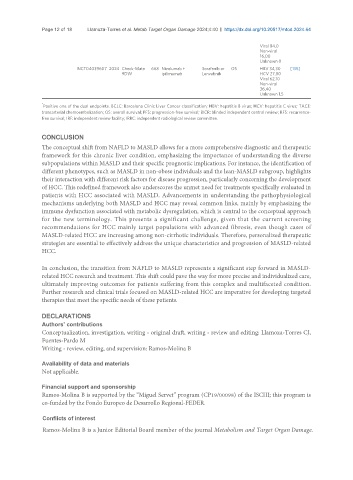
                           NCT04039607 2024 Check-Mate   668 Nivolumab +   Sorafenib or   OS  HBV 34,30   [135]
                                          9DW           ipilimumab   Lenvatinib          HCV 27,80
                                                                                         Viral 62,10
                                                                                         Non-viral
                                                                                         36,40
                                                                                         Unknown 1,5

               *
                Positive one of the dual endpoints. BCLC: Barcelona Clinic Liver Cancer classification; HBV: hepatitis B virus; HCV: hepatitis C virus; TACE:
               transarterial chemoembolization; OS: overall survival; PFS: progression-free survival; BICR: blinded independent central review; RFS: recurrence-
               free survival; IRF: independent review facility; IRRC: independent radiological review committee.

               CONCLUSION
               The conceptual shift from NAFLD to MASLD allows for a more comprehensive diagnostic and therapeutic
               framework for this chronic liver condition, emphasizing the importance of understanding the diverse
               subpopulations within MASLD and their specific prognostic implications. For instance, the identification of
               different phenotypes, such as MASLD in non-obese individuals and the lean-MASLD subgroup, highlights
               their interaction with different risk factors for disease progression, particularly concerning the development
               of HCC. This redefined framework also underscores the unmet need for treatments specifically evaluated in
               patients with HCC associated with MASLD. Advancements in understanding the pathophysiological
               mechanisms underlying both MASLD and HCC may reveal common links, mainly by emphasizing the
               immune dysfunction associated with metabolic dysregulation, which is central to the conceptual approach
               for the new terminology. This presents a significant challenge, given that the current screening
               recommendations for HCC mainly target populations with advanced fibrosis, even though cases of
               MASLD-related HCC are increasing among non-cirrhotic individuals. Therefore, personalized therapeutic
               strategies are essential to effectively address the unique characteristics and progression of MASLD-related
               HCC.


               In conclusion, the transition from NAFLD to MASLD represents a significant step forward in MASLD-
               related HCC research and treatment. This shift could pave the way for more precise and individualized care,
               ultimately improving outcomes for patients suffering from this complex and multifaceted condition.
               Further research and clinical trials focused on MASLD-related HCC are imperative for developing targeted
               therapies that meet the specific needs of these patients.


               DECLARATIONS
               Authors’ contributions
               Conceptualization, investigation, writing - original draft, writing - review and editing: Llamoza-Torres CJ,
               Fuentes-Pardo M
               Writing - review, editing, and supervision: Ramos-Molina B


               Availability of data and materials
               Not applicable.


               Financial support and sponsorship
               Ramos-Molina B is supported by the “Miguel Servet” program (CP19/00098) of the ISCIII; this program is
               co-funded by the Fondo Europeo de Desarrollo Regional-FEDER.


               Conflicts of interest
               Ramos-Molina B is a Junior Editorial Board member of the journal Metabolism and Target Organ Damage.

