


Page 32 - Read Online
P. 32
Page 12 of 19  Son et al. Microbiome Res Rep. 2025;4:29  https://dx.doi.org/10.20517/mrr.2025.14


     +
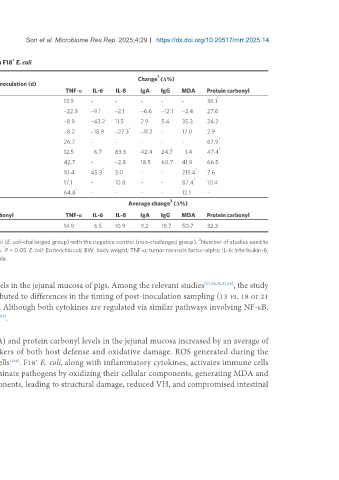
 Table 4. Changes in jejunal mucosal immunity and oxidative stress in nursery pigs challenged with F18  E. coli
                                                        1
                                                 Change  (Δ%)
 Ref.  Inoculation BW (kg)  Inoculation age (d)  Days post inoculation (d)
                        TNF-α     IL-6    IL-8    IgA     IgG    MDA      Protein carbonyl
 [23]                                                                        *
 Duarte and Kim  NA  28  21  13.9  -     -        -       -      -        36.1
 [27]
 Garavito-Duarte et al.  6.3  28  21  –22.3  –9.1  –2.1  –6.6  –12.1  –2.4  27.6
 [28]
 Gormley et al.  6.4  28  21  –8.9  –43.2  11.5   2.9     5.4    35.3     24.2
 [31]                                         *
 Deng et al.  6.6  28  18  –8.2  –18.9   –27.3    –11.2   -      17.0     2.9
 [9]                                                                          *
 Duarte et al.  6.9  28  21  26.7  -     -        -       -      -        67.9
 [30]                                                                         *
 Xu et al.  7.1  28  21  12.5    –6.7    83.3     42.4    24.7   –1.4     47.4
 [29]
 Jang et al.  7.2  28  21  42.7  -       –2.8     18.5    60.7   41.9     66.5
 [36]                                *                                *
 Duarte et al.  8.2  28  13  10.4  45.3  3.0      -       -      215.4    7.6
 [37]                                                                *
 Duarte et al.  8.2  NA  21  17.1  -     10.8     -       -      87.4     10.4
 [19]                       *
 Sun et al.  8.3  34  12  64.8   -       -        -       -      12.1     -
                                                             3
 Number of studies 2                          Average change  (Δ%)
 TNF-α  IL-6  IL-8  IgA  IgG  MDA  Protein carbonyl  TNF-α  IL-6  IL-8  IgA  IgG  MDA  Protein carbonyl
 10  5  7  5  4  8  9  14.9      –6.5    10.9     9.2     19.7   50.7     32.3

 1                                                                     2
 Percentage changes in immune and oxidative responses were calculated by comparing the positive control (E. coli-challenged group) with the negative control (non-challenged group).  Number of studies used to
 3  *
 calculate the average change in each indicator.  The average change was calculated as the arithmetic mean.  P < 0.05. E. coli: Escherichia coli; BW: body weight; TNF-α: tumor necrosis factor-alpha; IL-6: interleukin-6;
 IL-8: interleukin-8; IgA: immunoglobulin A; IgG: immunoglobulin G; MDA: malondialdehyde; NA: not available.


 Regarding IL-6, the F18  E. coli challenge does not consistently increase IL-6 levels in the jejunal mucosa of pigs. Among the relevant studies [27,28,30,31,36] , the study
 +
 by Duarte et al. reported an increase in IL-6 . This inconsistency may be attributed to differences in the timing of post-inoculation sampling (13 vs. 18 or 21
 [36]
 days). IL-6 typically rises and falls earlier than IL-8 in response to infection . Although both cytokines are regulated via similar pathways involving NF-κB,
 [102]
 IL-8 gene expression involves more complex regulatory mechanisms than IL-6 .
 [103]


 +
 Across the studies using F18  E. coli challenge models, malondialdehyde (MDA) and protein carbonyl levels in the jejunal mucosa increased by an average of
 50.7% and 32.3%, respectively [9,19,23,27-31,36,37] . These elevated levels serve as markers of both host defense and oxidative damage. ROS generated during the
 immune response oxidize lipids and amino acids in both host and bacterial cells . F18  E. coli, along with inflammatory cytokines, activates immune cells
             +
    [104]
 such as neutrophils and macrophages, which produce ROS . These ROS eliminate pathogens by oxidizing their cellular components, generating MDA and
 [105]
 protein carbonyl as by-products . However, ROS also oxidize host cell components, leading to structural damage, reduced VH, and compromised intestinal
 [106]
 integrity .
 [107]

