


Page 172 - Read Online
P. 172
D’Aimmo et al. Microbiome Res Rep 2024;3:11  https://dx.doi.org/10.20517/mrr.2023.59  Page 15 of 22

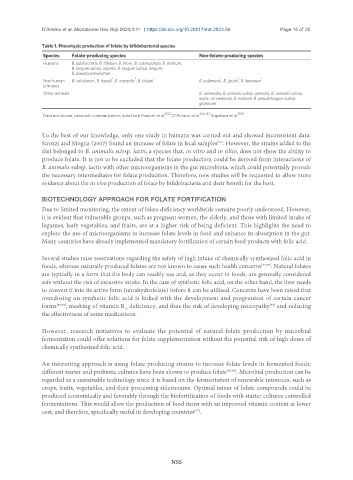
               Table 1. Phenotypic production of folate by bifidobacterial species
                Species  Folate-producing species                   Non-folate-producing species
                Humans   B. adolescentis, B. bifidum, B. breve, B. catenulatum, B. dentium,
                         B. longum subsp. infantis, B. longum subsp. longum,
                         B. pseudocatenulatum
                                 *     *      *      *                     *     *       *
                Non human   B. catulorum , B. hapali , B. myosotis , B. tissieri  B. eulemuris , B. jacchi , B. lemurum
                primates
                Other animals                                       B. asteroides, B. animalis subsp. animalis, B. animalis subsp.
                                                                    lactis, coryneforme, B. indicum, B. pseudolongum subsp.
                                                                    globosum

               *                                         [82]       [58,74]      [89]
                Data not shown, personal communication; data from Pompei et al.  ; D’Aimmo et al.  ; Sugahara et al.  .

               To the best of our knowledge, only one study in humans was carried out and showed inconsistent data:
               Strozzi and Mogna (2007) found an increase of folate in fecal samples . However, the strains added to the
                                                                          [92]
               diet belonged to B. animalis subsp. lactis, a species that, in vitro and in silico, does not show the ability to
               produce folate. It is not to be excluded that the folate production could be derived from interactions of
               B. animalis subsp. lactis with other microorganisms in the gut microbiota, which could potentially provide
               the necessary intermediates for folate production. Therefore, new studies will be requested to allow more
               evidence about the in vivo production of folate by bifidobacteria and their benefit for the host.

               BIOTECHNOLOGY APPROACH FOR FOLATE FORTIFICATION
               Due to limited monitoring, the extent of folate deficiency worldwide remains poorly understood. However,
               it is evident that vulnerable groups, such as pregnant women, the elderly, and those with limited intake of
               legumes, leafy vegetables, and fruits, are at a higher risk of being deficient. This highlights the need to
               explore the use of microorganisms to increase folate levels in food and enhance its absorption in the gut.
               Many countries have already implemented mandatory fortification of certain food products with folic acid.


               Several studies raise reservations regarding the safety of high intake of chemically synthesized folic acid in
               foods, whereas naturally produced folates are not known to cause such health concerns [67,68] . Natural folates
               are typically in a form that the body can readily use and, as they occur in foods, are generally considered
               safe without the risk of excessive intake. In the case of synthetic folic acid, on the other hand, the liver needs
               to convert it into its active form (tetrahydrofolate) before it can be utilized. Concerns have been raised that
               overdosing on synthetic folic acid is linked with the development and progression of certain cancer
                                                                                            [59]
               forms [93,94] , masking of vitamin B  deficiency, and thus the risk of developing neuropathy  and reducing
                                           12
               the effectiveness of some medications.
               However, research initiatives to evaluate the potential of natural folate production by microbial
               fermentation could offer solutions for folate supplementation without the potential risk of high doses of
               chemically synthesized folic acid.


               An interesting approach is using folate-producing strains to increase folate levels in fermented foods;
               different starter and probiotic cultures have been shown to produce folate [95,96] . Microbial production can be
               regarded as a sustainable technology since it is based on the fermentation of renewable resources, such as
               crops, fruits, vegetables, and their processing sidestreams. Optimal mixes of folate compounds could be
               produced economically and favorably through the biofortification of foods with starter cultures controlled
               fermentations. This would allow the production of food items with an improved vitamin content at lower
               cost, and therefore, specifically useful in developing countries .
                                                                   [97]

