


Page 169 - Read Online
P. 169
Page 12 of 22              D’Aimmo et al. Microbiome Res Rep 2024;3:11  https://dx.doi.org/10.20517/mrr.2023.59


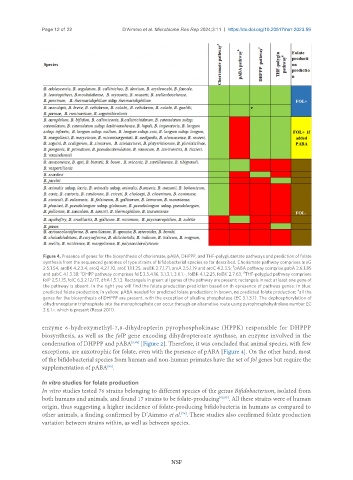
                Figure 4. Presence of genes for the biosynthesis of chorismate, pABA, DHPPP, and THF-polyglutamate pathways and prediction of folate
                synthesis from the sequenced genomes of type strains of bifidobacterial species so far described. Chorismate pathway comprises aroG
                                                                               b
                2.5.1.54, aroBK 4.2.3.4, aroQ 4.2.1.10, aroE 1.1.1.25, aroBK 2.7.1.71, aroA 2.5.1.19 and aroC 4.2.3.5;  pABA pathway comprise pabA 2.6.1.85
                            c
                                                                                   d
                and pabC 4.1.3.38;  DHPP pathway comprises folE 3.5.4.16, 3.1.3.1, 3.6.1.-, folBK 4.1.2.25, folBK 2.7.63;  THF-polyglud pathway comprises
                folP 2.5.1.15, folC 6.3.2.12/17, dfrA 1.5.1.3. Rectangels in green: all genes of the pathway are present; rectangels in red: at least one gene of
                the pathway is absent. In the right you will find the folate production prediction based on th epresence of pathwas genes: in blue:
                                                                                                     e
                predicted folate production; in yellow: pABA needed for predicted folate production; in brown, no predicted folate production;  all the
                genes for the biosynthesis of DHPPP are present, with the exception of alkaline phosphatase (EC 3.1.3.1). The dephosphorylation of
                dihydroneopterin triphosphate into the monophosphate can occur through an alternative route using pyrophosphohydrolase number EC
                3.6.1.-. which is present (Rossi 2011).
               enzyme 6-hydroxymethyl-7,8-dihydropterin pyrophosphokinase (HPPK) responsible for DHPPP
               biosynthesis, as well as the folP gene encoding dihydropteroate synthase, an enzyme involved in the
               condensation of DHPPP and pABA [5,88]  [Figure 2]. Therefore, it was concluded that animal species, with few
               exceptions, are auxotrophic for folate, even with the presence of pABA [Figure 4]. On the other hand, most
               of the bifidobacterial species from human and non-human primates have the set of fol genes but require the
               supplementation of pABA .
                                     [65]

               In vitro studies for folate production
               In vitro studies tested 76 strains belonging to different species of the genus Bifidobacterium, isolated from
               both humans and animals, and found 17 strains to be folate-producing [62,63] . All these strains were of human
               origin, thus suggesting a higher incidence of folate-producing bifidobacteria in humans as compared to
               other animals, a finding confirmed by D’Aimmo et al. . These studies also confirmed folate production
                                                              [74]
               variation between strains within, as well as between species.

