


Page 19 - Read Online
P. 19
Page 10 of 11             Matto et al. Mini-invasive Surg. 2025;9:19  https://dx.doi.org/10.20517/2574-1225.2025.51

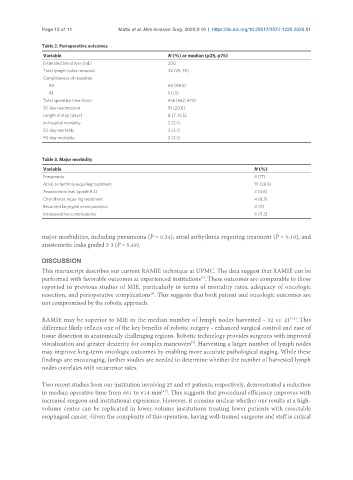
               Table 2. Perioperative outcomes
                Variable                                  N (%) or median (p25, p75)
                Estimated blood loss (mL)                 200
                Total lymph nodes removed                 32 (25, 39)
                Completeness of resection
                  R0                                      64 (98.5)
                  R1                                      1 (1.5)
                Total operative time (min)                614 (562, 673)
                30-day readmission                        13 (20.6)
                Length of stay (days)                     8 (7, 13.5)
                In-hospital mortality                     2 (3.1)
                30-day mortality                          2 (3.1)
                90-day mortality                          2 (3.1)


               Table 3. Major morbidity
                Variable                                                               N (%)
                Pneumonia                                                              9 (17)
                Atrial arrhythmia requiring treatment                                  19 (38.8)
                Anastomotic leak (grade ≥ 3)                                           3 (4.6)
                Chylothorax requiring treatment                                        4 (8.3)
                Recurrent laryngeal nerve paralysis                                    0 (0)
                Intraoperative complications                                           6 (9.2)


               major morbidities, including pneumonia (P = 0.34), atrial arrhythmia requiring treatment (P = 0.19), and
               anastomotic leaks graded ≥ 3 (P = 0.49).

               DISCUSSION
               This manuscript describes our current RAMIE technique at UPMC. The data suggest that RAMIE can be
               performed with favorable outcomes at experienced institutions . These outcomes are comparable to those
                                                                     [5]
               reported in previous studies of MIE, particularly in terms of mortality rates, adequacy of oncologic
               resection, and perioperative complications . This suggests that both patient and oncologic outcomes are
                                                    [5]
               not compromised by the robotic approach.

               RAMIE may be superior to MIE in the median number of lymph nodes harvested - 32 vs. 21 . This
                                                                                                   [4,5]
               difference likely reflects one of the key benefits of robotic surgery - enhanced surgical control and ease of
               tissue dissection in anatomically challenging regions. Robotic technology provides surgeons with improved
                                                                 [8]
               visualization and greater dexterity for complex maneuvers . Harvesting a larger number of lymph nodes
               may improve long-term oncologic outcomes by enabling more accurate pathological staging. While these
               findings are encouraging, further studies are needed to determine whether the number of harvested lymph
               nodes correlates with recurrence rates.


               Two recent studies from our institution involving 25 and 65 patients, respectively, demonstrated a reduction
               in median operative time from 661 to 614 min . This suggests that procedural efficiency improves with
                                                       [5,7]
               increased surgeon and institutional experience. However, it remains unclear whether our results at a high-
               volume center can be replicated in lower-volume institutions treating fewer patients with resectable
               esophageal cancer. Given the complexity of this operation, having well-trained surgeons and staff is critical

