


Page 34 - Read Online
P. 34
Garro-Núñez et al. J Transl Genet Genom 2022;6:361-74  https://dx.doi.org/10.20517/jtgg.2022.10  Page 363

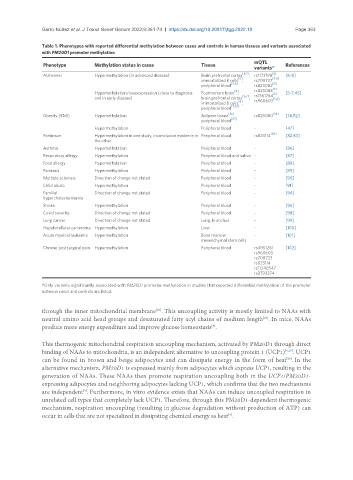
               Table 1. Phenotypes with reported differential methylation between cases and controls in human tissues and variants associated
               with PM20D1 promoter methylation
                                                                                       mQTL
                Phenotype        Methylation status in cases         Tissue                      References
                                                                                       variants*
                                                                                   [6,7]     [5]
                Alzheimer        Hypermethylation (in advanced disease)  Brain prefrontal cortex  ,  rs1172198    [6-8]
                                                                                 [6]
                                                                     immortalized B cells ,   rs708727 [5-8]
                                                                               [7,8]         [5]
                                                                     peripheral blood  rs823082
                                                                                             [5]
                                                                                [5]    rs823088
                                 Hypomethylation/overexpression (close to diagnosis   Postmortem brain ,    [5]  [5-7,45]
                                                                                   [6,7]  rs1361754
                                 and in early disease)               brain prefrontal cortex  ,    [5,6]
                                                                                 [6]   rs960603
                                                                     immortalized B cells ,
                                                                     peripheral blood [7,45]
                                                                              [36]           [36]
                Obesity (BMI)    Hypomethylation                     Adipose tissue  ,    rs823080  [36,52]
                                                                     peripheral blood [52]
                                 Hypermethylation                    Peripheral blood  -         [47]
                Parkinson        Hypermethylation in one study, inconclusive evidence in  Peripheral blood  rs823114 [83]  [82,83]
                                 the other
                Asthma           Hypomethylation                     Peripheral blood  -         [86]
                Respiratory allergy  Hypermethylation                Peripheral blood and saliva -  [87]
                Food allergy     Hypomethylation                     Peripheral blood  -         [88]
                Psoriasis        Hypermethylation                    Peripheral blood  -         [89]
                Multiple sclerosis   Direction of change not stated   Peripheral blood  -        [90]
                Child abuse      Hypermethylation                    Peripheral blood  -         [91]
                Familial         Direction of change not stated      Peripheral blood  -         [94]
                hypercholesterolemia
                Stroke           Hypermethylation                    Peripheral blood  -         [96]
                Covid severity   Direction of change not stated      Peripheral blood  -         [98]
                Lung cancer      Direction of change not stated      Lung, bronchus    -         [99]
                Hepatocellular carcinoma  Hypermethylation           Liver             -         [100]
                Acute myeloid leukemia   Hypermethylation            Bone marrow       -         [101]
                                                                     mesenchymal stem cells
                Chronic postsurgical pain  Hypermethylation          Peripheral blood  rs4951261   [102]
                                                                                       rs960603
                                                                                       rs708723
                                                                                       rs823114
                                                                                       rs11240547
                                                                                       rs2793374

               *Only variants significantly associated with PM20D1 promoter methylation in studies that reported differential methylation of the promoter
               between cases and controls are listed.


               through the inner mitochondrial membrane . This uncoupling activity is mostly limited to NAAs with
                                                      [27]
                                                                                          [23]
               neutral amino acid head groups and desaturated fatty acyl chains of medium length . In mice, NAAs
               produce more energy expenditure and improve glucose homeostasis .
                                                                        [9]
               This thermogenic mitochondrial respiration uncoupling mechanism, activated by PM20D1 through direct
               binding of NAAs to mitochondria, is an independent alternative to uncoupling protein 1 (UCP1) [9,25] . UCP1
               can be found in brown and beige adipocytes and can dissipate energy in the form of heat . In the
                                                                                                  [28]
               alternative mechanism, PM20D1 is expressed mainly from adipocytes which express UCP1, resulting in the
               generation of NAAs. These NAAs then promote respiration uncoupling both in the UCP1/PM20D1-
               expressing adipocytes and neighboring adipocytes lacking UCP1, which confirms that the two mechanisms
                             [9]
               are independent . Furthermore, in vitro evidence exists that NAAs can induce uncoupled respiration in
               unrelated cell types that completely lack UCP1. Therefore, through this PM20D1-dependent thermogenic
               mechanism, respiration uncoupling (resulting in glucose degradation without production of ATP) can
               occur in cells that are not specialized in dissipating chemical energy as heat .
                                                                              [9]

