


Page 37 - Read Online
P. 37
Page 366            Garro-Núñez et al. J Transl Genet Genom 2022;6:361-74  https://dx.doi.org/10.20517/jtgg.2022.10


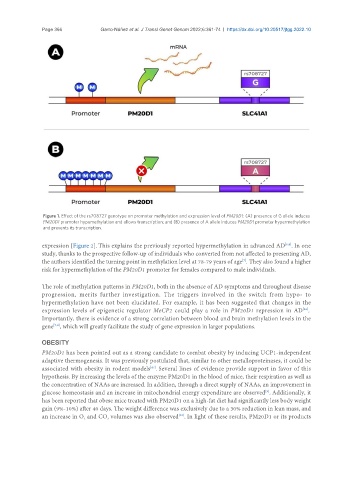
                Figure 1. Effect of the rs708727 genotype on promoter methylation and expression level of PM20D1: (A) presence of G allele induces
                PM20D1 promoter hypomethylation and allows transcription; and (B) presence of A allele induces PM20D1 promoter hypermethylation
                and prevents its transcription.

               expression [Figure 2]. This explains the previously reported hypermethylation in advanced AD . In one
                                                                                                 [6,8]
               study, thanks to the prospective follow-up of individuals who converted from not affected to presenting AD,
               the authors identified the turning point in methylation level at 78-79 years of age . They also found a higher
                                                                                   [7]
               risk for hypermethylation of the PM20D1 promoter for females compared to male individuals.


               The role of methylation patterns in PM20D1, both in the absence of AD symptoms and throughout disease
               progression,  merits  further  investigation.  The  triggers  involved  in  the  switch  from  hypo-  to
               hypermethylation have not been elucidated. For example, it has been suggested that changes in the
                                                                                                       [46]
               expression levels of epigenetic regulator MeCP2 could play a role in PM20D1 repression in AD .
               Importantly, there is evidence of a strong correlation between blood and brain methylation levels in the
                   [7,8]
               gene , which will greatly facilitate the study of gene expression in larger populations.

               OBESITY
               PM20D1 has been pointed out as a strong candidate to combat obesity by inducing UCP1-independent
               adaptive thermogenesis. It was previously postulated that, similar to other metalloproteinases, it could be
                                                    [47]
               associated with obesity in rodent models . Several lines of evidence provide support in favor of this
               hypothesis. By increasing the levels of the enzyme PM20D1 in the blood of mice, their respiration as well as
               the concentration of NAAs are increased. In addition, through a direct supply of NAAs, an improvement in
               glucose homeostasis and an increase in mitochondrial energy expenditure are observed . Additionally, it
                                                                                          [9]
               has been reported that obese mice treated with PM20D1 on a high-fat diet had significantly less body weight
               gain (9%-10%) after 40 days. The weight difference was exclusively due to a 30% reduction in lean mass, and
               an increase in O  and CO  volumes was also observed . In light of these results, PM20D1 or its products
                                                             [48]
                             2
                                     2

