


Page 38 - Read Online
P. 38
Garro-Núñez et al. J Transl Genet Genom 2022;6:361-74  https://dx.doi.org/10.20517/jtgg.2022.10  Page 367


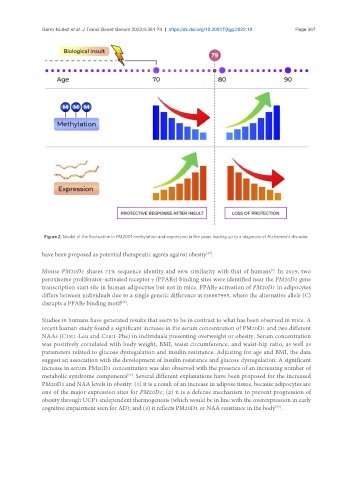
                Figure 2. Model of the fluctuation in PM20D1 methylation and expression in the years leading up to a diagnosis of Alzheimer’s disorder.


                                                                       [49]
               have been proposed as potential therapeutic agents against obesity .
               Mouse PM20D1 shares 71% sequence identity and 86% similarity with that of humans . In 2019, two
                                                                                            [9]
               peroxisome proliferator-activated receptor γ (PPARγ) binding sites were identified near the PM20D1 gene
               transcription start site in human adipocytes but not in mice. PPARγ activation of PM20D1 in adipocytes
               differs between individuals due to a single genetic difference at rs6667995, where the alternative allele (C)
               disrupts a PPARγ binding motif .
                                          [36]
               Studies in humans have generated results that seem to be in contrast to what has been observed in mice. A
               recent human study found a significant increase in the serum concentration of PM20D1 and two different
               NAAs (C18:1-Leu and C18:1-Phe) in individuals presenting overweight or obesity. Serum concentration
               was positively correlated with body weight, BMI, waist circumference, and waist-hip ratio, as well as
               parameters related to glucose dysregulation and insulin resistance. Adjusting for age and BMI, the data
               suggest an association with the development of insulin resistance and glucose dysregulation. A significant
               increase in serum PM20D1 concentration was also observed with the presence of an increasing number of
               metabolic syndrome components . Several different explanations have been proposed for the increased
                                            [50]
               PM20D1 and NAA levels in obesity: (1) it is a result of an increase in adipose tissue, because adipocytes are
               one of the major expression sites for PM20D1; (2) it is a defense mechanism to prevent progression of
               obesity through UCP1-independent thermogenesis (which would be in line with the overexpression in early
               cognitive impairment seen for AD); and (3) it reflects PM20D1 or NAA resistance in the body .
                                                                                              [50]

