


Page 34 - Read Online
P. 34
Lyulcheva-Bennett et al. J Transl Genet Genom 2023;7:259-73  https://dx.doi.org/10.20517/jtgg.2023.33   Page 265


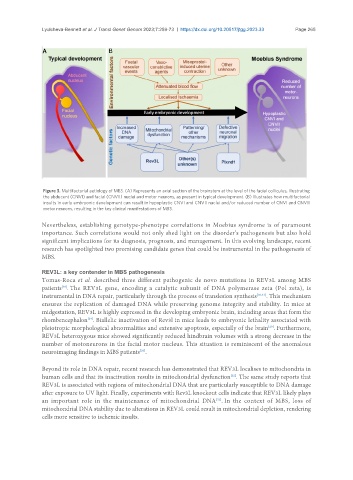
                Figure 3. Multifactorial aetiology of MBS. (A) Represents an axial section of the brainstem at the level of the facial colliculus, illustrating
                the abducent (CNVI) and facial (CNVII) nuclei and motor neurons, as present in typical development. (B) Illustrates how multifactorial
                insults in early embryonic development can result in hypoplastic CNVI and CNVII nuclei and/or reduced number of CNVI and CNVII
                motor neurons, resulting in the key clinical manifestations of MBS.
               Nevertheless, establishing genotype-phenotype correlations in Moebius syndrome is of paramount
               importance. Such correlations would not only shed light on the disorder’s pathogenesis but also hold
               significant implications for its diagnosis, prognosis, and management. In this evolving landscape, recent
               research has spotlighted two promising candidate genes that could be instrumental in the pathogenesis of
               MBS.


               REV3L: a key contender in MBS pathogenesis
               Tomas-Roca et al. described three different pathogenic de novo mutations in REV3L among MBS
               patients . The REV3L gene, encoding a catalytic subunit of DNA polymerase zeta (Pol zeta), is
                      [29]
               instrumental in DNA repair, particularly through the process of translesion synthesis [30,31] . This mechanism
               ensures the replication of damaged DNA while preserving genome integrity and stability. In mice at
               midgestation, REV3L is highly expressed in the developing embryonic brain, including areas that form the
               rhombencephalon . Biallelic inactivation of Rev3l in mice leads to embryonic lethality associated with
                               [29]
               pleiotropic morphological abnormalities and extensive apoptosis, especially of the brain . Furthermore,
                                                                                           [29]
               REV3L heterozygous mice showed significantly reduced hindbrain volumes with a strong decrease in the
               number of motoneurons in the facial motor nucleus. This situation is reminiscent of the anomalous
                                                [29]
               neuroimaging findings in MBS patients .

               Beyond its role in DNA repair, recent research has demonstrated that REV3L localises to mitochondria in
               human cells and that its inactivation results in mitochondrial dysfunction . The same study reports that
                                                                               [32]
               REV3L is associated with regions of mitochondrial DNA that are particularly susceptible to DNA damage
               after exposure to UV light. Finally, experiments with Rev3L knockout cells indicate that REV3L likely plays
                                                                          [32]
               an important role in the maintenance of mitochondrial  DNA . In the context of MBS, loss of
               mitochondrial DNA stability due to alterations in REV3L could result in mitochondrial depletion, rendering
               cells more sensitive to ischemic insults.

