


Page 32 - Read Online
P. 32
Lyulcheva-Bennett et al. J Transl Genet Genom 2023;7:259-73  https://dx.doi.org/10.20517/jtgg.2023.33   Page 263

               Table 1. Proposed diagnostic criteria for MBS utilising a combination of essential and supporting features to facilitate standardised
               MBS diagnosis and reporting
                Diagnosis  Criteria                                 Supporting features
                Typical MBS    Essential features:                  Neurological:
                             •Bilateral congenital, non-progressive CNVI palsy   •Involvement of other cranial nerves
                           •Bilateral congenital, non-progressive CNVII palsy   •Hypotonia
                           •Presence of a full vertical gaze        •Dysarthria
                                                                    •Abnormal motor coordination
                           Presence of all three essential features (bilateral or unilateral)  •Brain imaging abnormalities (e.g., volumetric reduction in
                           plus ≥ 2 supporting features in the absence of chromosome  key brainstem areas)
                           abnormalities                             Musculoskeletal:

                                                                    •Lower limb anomalies (e.g., talipes)
                                                                    •Upper limb anomalies (e.g., Poland anomaly,
                                                                    symbrachydactyly)

                                                                    Craniofacial:
                Isolated MBS    Presence of all three essential features (bilateral or unilateral)  •Craniofacial dysmorphism (e.g., low set/dysplastic ears,
                           plus ≤ 1 supporting features in the absence of chromosome      hypertelorism, epicanthic folds)
                           abnormalities                            •High or cleft palate
                                                                    •Micrognathia
                                                                    •Hypoplastic/atrophic tongue

                                                                    Gastrointestinal/Nutritional:
                                                                    •Swallowing/feeding difficulties
                                                                    •Failure to thrive
                                                                    Cardiovascular:
                                                                    •Cardiac anomalies (e.g., dextrocardia, atrial/ventricular
                                                                    septal defects, transposition of the great vessels)
                                                                    Developmental:
                                                                    •Developmental delay
                                                                    •Sleep problems
                                                                    •Behavioural and/or social communication difficulties
                Alternative   •Presence of only two essential features with or without supporting features
                diagnosis likely      ·Presence of three essential features and one of: atypical additional features, such as profound intellectual disability or
                           atypical dysmorphic features
                               ·Family history

               Based on our centre’s recent experience of 42 MBS patients, where 97% of MBS patients meet the diagnostic criteria for “Typical MBS” (n = 37)
               of all essential MBS features and ≥ 2 supporting features in the absence of chromosome abnormalities. 84% (n = 32) of our cohort presented with
               the essential features and ≥ 3 supporting features.


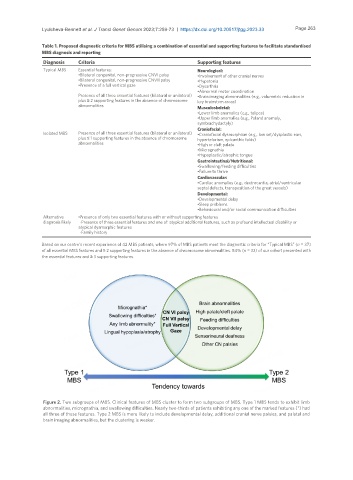
                Figure 2. Two subgroups of MBS. Clinical features of MBS cluster to form two subgroups of MBS. Type 1 MBS tends to exhibit limb
                abnormalities, micrognathia, and swallowing difficulties. Nearly two-thirds of patients exhibiting any one of the marked features (*) had
                all three of those features. Type 2 MBS is more likely to include developmental delay, additional cranial nerve palsies, and palatal and
                brain imaging abnormalities, but the clustering is weaker.

